

Introduction: Welcome to the Arena
If you are reading this, you’ve likely realized that the “easy money” days of blindly throwing cash at a memecoin and waking up rich are mostly behind us. Welcome to 2026.
The crypto market has matured. It’s no longer the Wild West it was five years ago; it is now a sophisticated, high-speed financial arena dominated by institutional giants, AI trading bots, and savvy retail traders.
But here is the good news: It is more profitable than ever if you know what you are doing.
In 2026, volatility hasn’t disappeared; it has just become more structured. With the rise of Layer-2 networks, Real World Assets (RWAs), and AI-integrated trading terminals, the opportunities to make life-changing wealth are vast.
But so are the risks. This crypto trading for beginners guide is not a “get rich quick” scheme. It is a battle manual. We are going to strip away the jargon, ignore the hype, and teach you the raw mechanics of crypto trading for beginners.
We will cover everything from setting up your first secure wallet to executing complex leveraged trades, managing your psychology, and automating your strategy.
Grab a coffee. This is going to be a long ride.
Before placing your first trade, securing your starting capital in a non-custodial wallet is vital. Compare the leading options in our guide to crypto wallet apps and wallet types, including hot and cold storage solutions.
How We Evaluated Platforms & Tools For This 2026 Guide
Navigating the 2026 crypto ecosystem requires filtering through hundreds of exchanges, trading bots, and charting platforms. To ensure every recommendation in this handbook is safe and reliable for beginners, our editorial team applied a strict four-step evaluation process:
- Fee Transparency & Liquidity: We verified order book depth and taker/maker fee schedules across major CEXs and DEXs to ensure minimal slippage on small-to-medium trade volumes.
- Regulatory Compliance & Security: We prioritized platforms offering robust cold-storage reserves, proof-of-reserves (PoR) audits, and mandatory two-factor authentication (2FA).
- User Interface & Tooling: We tested mobile apps and web terminals specifically for order-execution responsiveness, clear stop-loss interfaces, and clean chart integration.
- Hands-On Testing: Every trading bot, hardware wallet, and exchange featured in this guide was tested with live funds or active paper-trading accounts.
Key Takeaways (Crypto trading for beginners guide)
- Trading vs. Investing: Trading focuses on short-term price action, while investing (HODLing) is about long-term belief.
- Risk Management: Never risk more than 1-2% of your capital on a single trade.
- The 2026 Landscape: AI bots and institutional money now dominate; you must trade smarter, not harder.
- Tools matter: Use a dedicated laptop and professional charting software like TradingView, not just a phone app.
- Psychology is key: Managing FOMO and avoiding revenge trading is 90% of the battle in crypto trading for beginners.
Part 1: The Foundation – Before You Buy a Single Coin
What Actually Is Trading? (vs. Investing)
Before we dive in, let’s clear up a misconception. Trading is not investing.
- Investing (HODLing): You buy Bitcoin or Solana because you believe that in 5 years, it will be worth 10x more. You don’t care if it drops 20% tomorrow. You are passive.
- Trading: You buy an asset because you believe it will go up (or down) soon—in minutes, hours, or days. You are capitalizing on volatility. You don’t necessarily care about the long-term “vision” of the coin; you care about the price action.
In 2026, the lines have blurred slightly with “Liquid Staking” and “Restaking.” For traders who want passive income from idle holdings, our guide to the best crypto staking platforms covers those options. But the core principle remains: Traders seek short-term profit; Investors seek long-term wealth. This crypto trading for beginners guide is specifically for Traders.
The 2026 Landscape: What Changed?
If you traded in 2021, forget what you know. 2026 is different.
- Regulation: Most major trading platforms (Binance, BingX, Bybit) now require strict KYC (Know Your Customer). You can’t hide. Taxes are automated in many regions.
- AI Dominance: Algorithms now control significantly more volume. You are trading against bots that can execute orders in milliseconds.
- Fees are Lower: Competition has driven trading fees to near zero on many platforms, making high-frequency strategies like scalping more viable for those starting crypto trading for beginners.
- DeFi is Usable: Decentralized Exchanges (DEXs) like Uniswap V5 or Jupiter have user experiences that rival Centralized exchanges.
While choosing a tier-1 exchange depends on your regional availability and feature preferences, evaluating fee structures beforehand prevents unexpected trading costs. Read our in-depth Binance exchange review 2026, BingX Copy Trading Review 2026, or explore passive options in our Bybit Global Exchange review 2026.
Centralized vs. Decentralized Exchanges (CEX vs. DEX)
You need a place to trade. You have two main choices.
1. Centralized Exchanges (CEX) Examples: Binance, Bybit, PrimeXBT, Delta (Indian users).
- Pros: High liquidity (easy to buy/sell huge amounts), easy interface, customer support, fiat on-ramps (bank transfers).
- Cons: “Not your keys, not your crypto.” If the exchange goes bankrupt, you lose your money.
- Verdict: Start here. The ease of use and safety nets are necessary when you are learning the ropes of crypto trading for beginners.
Choosing between centralized liquidity and self-custodial freedom is one of the most critical decisions for a new trader. To compare feature sets across major platforms, check out our best all-in-one crypto exchange platforms.
2. Decentralized Exchanges (DEX) Examples: Uniswap (Ethereum), Jupiter (Solana), Aerodrome (Base).
- Pros: You keep control of your funds (self-custody). No KYC required.
- Cons: Complex to use. If you lose your wallet password, your money is gone forever.
- Verdict: Use this only once you are comfortable with wallets like MetaMask or Phantom.
Read our head-to-head breakdown on CEX vs DEX vs Hybrid Exchange: The Global Crypto Battle (2026). If your main priority is minimizing fiat deposit fees, browse The Cheapest Ways to Buy Crypto Instantly in 2026 (Stop Wasting Money.
Setting Up Your Command Center
You don’t need 6 monitors like a Wall Street movie. But you do need the right tools.
- The Hardware: A reliable laptop is better than a phone. Mobile trading is fine for checking prices, but never do technical analysis on a phone screen.
- The Charting Software: TradingView is the industry standard. Claim a 30-day free trial. You will spend 90% of your time here.
- The Journal: A spreadsheet (Excel/Google Sheets) or a dedicated app. If you don’t track your trades, you are gambling, not trading.
- The News Feed: Twitter (X) is still the heartbeat of crypto. Create a dedicated “Alpha” list of reliable news aggregators.
While major global exchanges enforce mandatory identity verification, some traders prefer privacy-focused platforms for smaller trial positions. If you want to start trading without sending identity documents, explore our guide to the best no-KYC crypto exchanges.
Click here to get a 30-day free trial of TradingViewPart 2: The Mechanics – How to Execute Trades
This is where money changes hands. Any decent crypto trading for beginners guide will tell you to understand the buttons before you push them.
Spot Trading vs. Derivatives
- Spot Trading: You are buying the actual asset. If you need to understand the different categories before jumping in, our guide to types of cryptocurrencies explains them. If you buy 1 BTC, you own 1 BTC. You can withdraw it to a hardware wallet.
- Risk: Limited to your investment.
- Derivatives (Futures/Perpetuals): You are betting on the price of the asset without owning it. You are trading a contract.
- Risk: You can lose more than your initial trade amount if not isolated.
Understanding Order Types
Never just click “Buy.” Know how you are buying.
- Market Order: “I want to buy NOW at whatever the current price is.”
- Limit Order: “I want to buy ONLY if the price drops to $50,000.”
- Stop-Loss (SL): “If the price drops to $49,000, sell automatically to prevent further loss.”
- Golden Rule: Never enter a trade without a Stop-Loss. It is your safety net in crypto trading for beginners.
- Take-Profit (TP): “If the price hits $55,000, sell automatically to lock in my gains.”
Leverage: The Double-Edged Sword
Leverage allows you to borrow money from the exchange to increase your position size.
- Example: You have $1,000. You use 10x Leverage. You are now trading with $10,000.
- The Upside: If Bitcoin goes up 5%, your position goes up 50% ($500 profit instead of $50).
- The Downside: If Bitcoin goes down 5%, your position goes down 50%. If it drops 10%, you get liquidated—the exchange takes your original $1,000, and you are left with nothing.
Beginner Advice: Do not touch leverage above 2x-3x until you have been profitable for 6 months. High leverage (50x, 100x) is a trap designed to take your money, a common pitfall in crypto trading for beginners.
While leverage can drastically multiply profits, using high margin without strict stop-loss rules is the fastest way for beginners to get liquidated. Once you have built a consistent win rate in demo mode, compare order execution speeds across the best high-leverage crypto margin trading platforms.
Shorting: How to Profit When Prices Crash
“Shorting” means selling an asset you don’t own, with the promise to buy it back later.
- You borrow 1 BTC from the exchange when the price is $100,000.
- You instantly sell it for $100,000 cash.
- The price crashes to $80,000.
- You buy back 1 BTC for $80,000.
- You return the 1 BTC to the exchange.
- You keep the $20,000 difference.
Shorting allows you to make money in a Bear Market, effectively doubling your opportunities.
Part 3: Technical Analysis (TA) – Reading the Matrix
Technical Analysis is the art of predicting future price movements based on past price action. It is not magic; it is the study of mass psychology. If you want to master crypto trading for beginners, you have to speak the language of charts.
Candlestick Anatomy 101
Crypto charts are usually composed of “Candlesticks.”
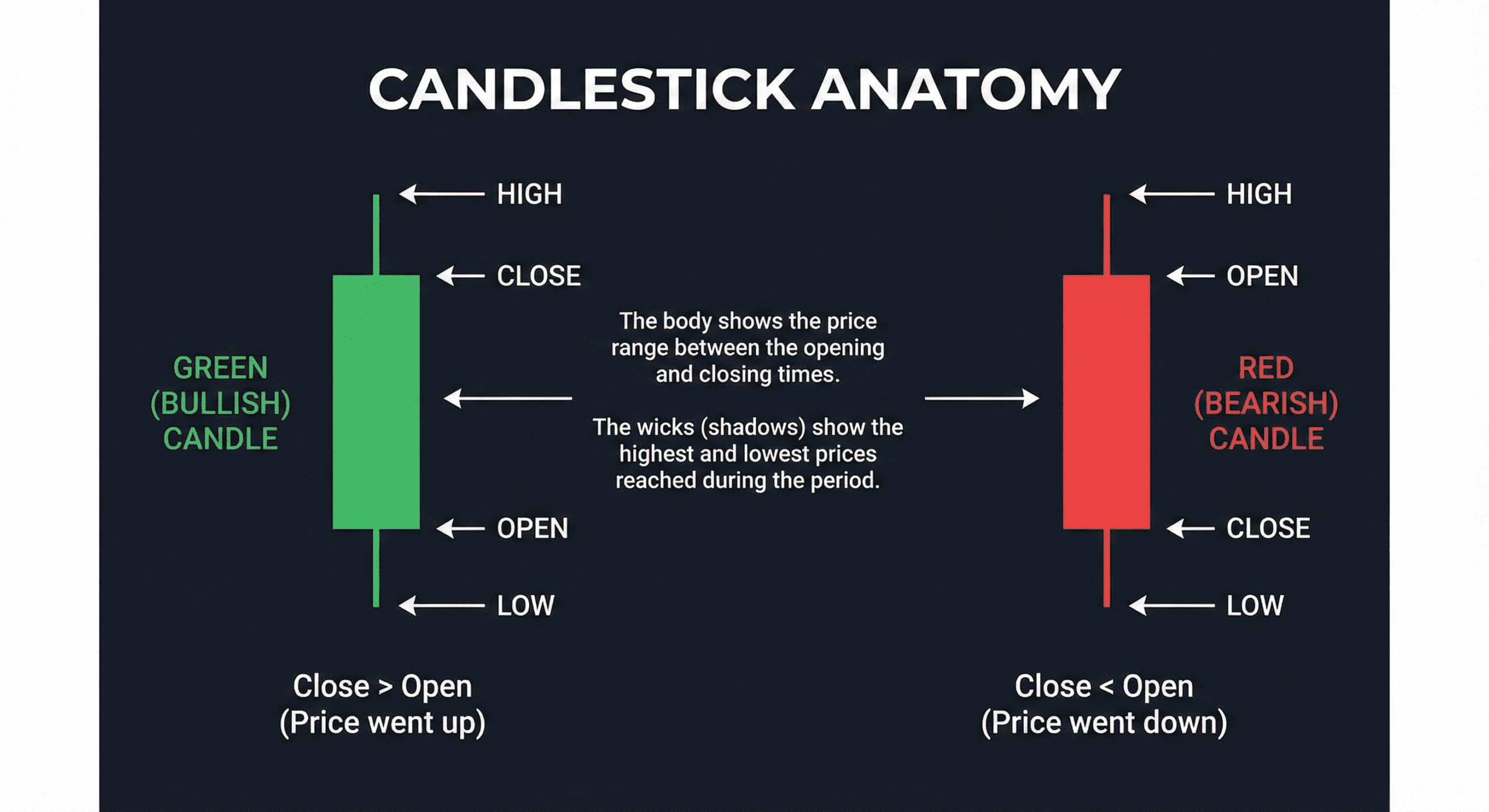
- The Body (Green/Red): Shows the opening and closing price.
- Green: Price closed higher than it opened (Bullish).
- Red: Price closed lower than it opened (Bearish).
- The Wicks (Shadows): The thin lines above and below. They show the highest and lowest prices reached during that time period.
Major Candlestick Patterns
You need to spot these patterns instantly. They are the market’s way of whispering hints to you, a critical skill in crypto trading for beginners.
1. The Hammer (Bullish)
This looks like a hammer with a small body at the top and a long wick at the bottom. It means sellers pushed the price down, but buyers came in strong and pushed it back up. It usually happens at the bottom of a downtrend.
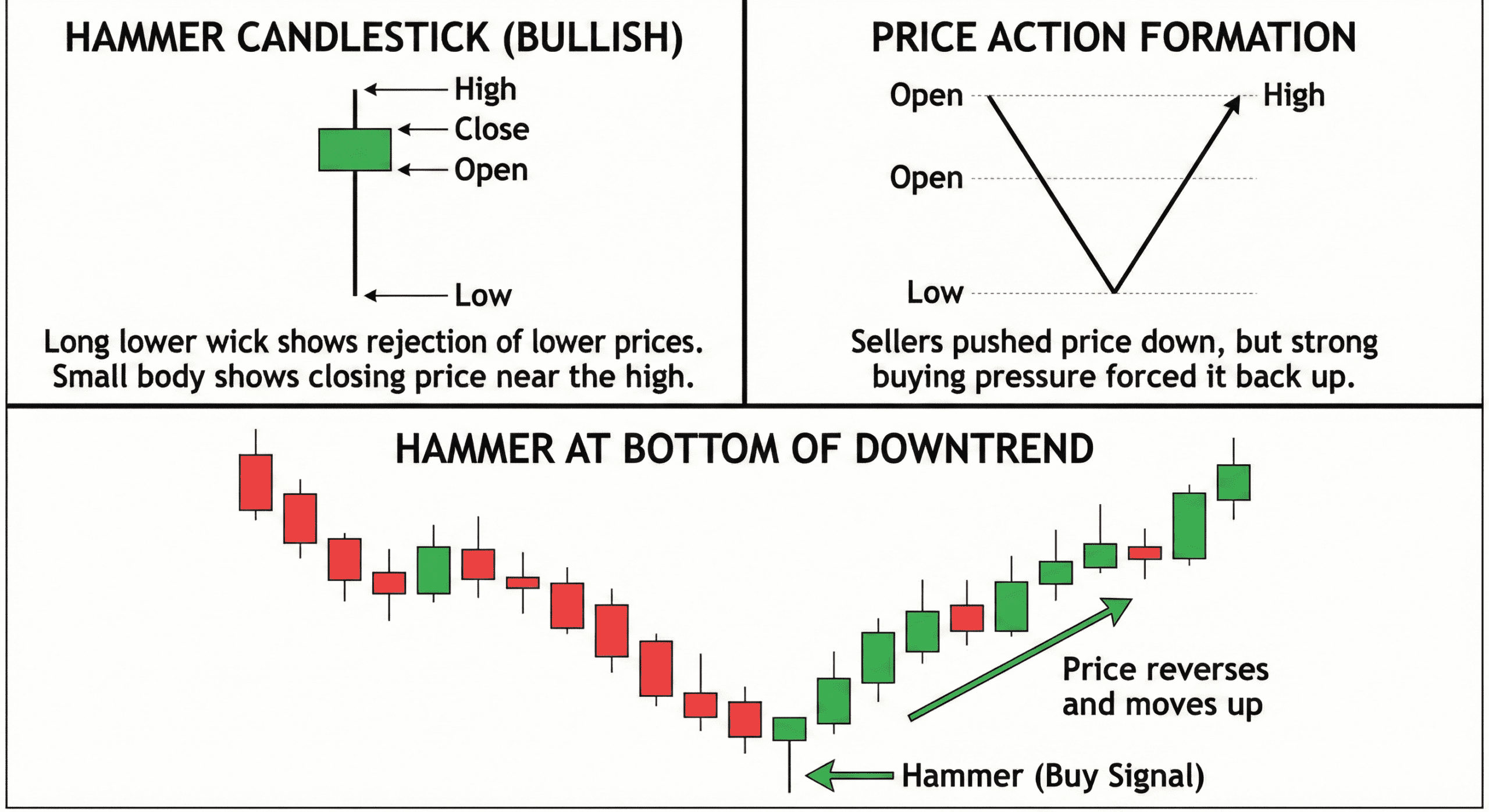
- How to trade it: Buy when the next candle closes above the hammer. Place your Stop Loss below the wick.
2. The Inverted Hammer (Bullish)
This is a hammer flipped upside down. It appears during a downtrend. It shows that buyers tried to push the price up, and even though sellers pushed it back, the buying pressure is building.
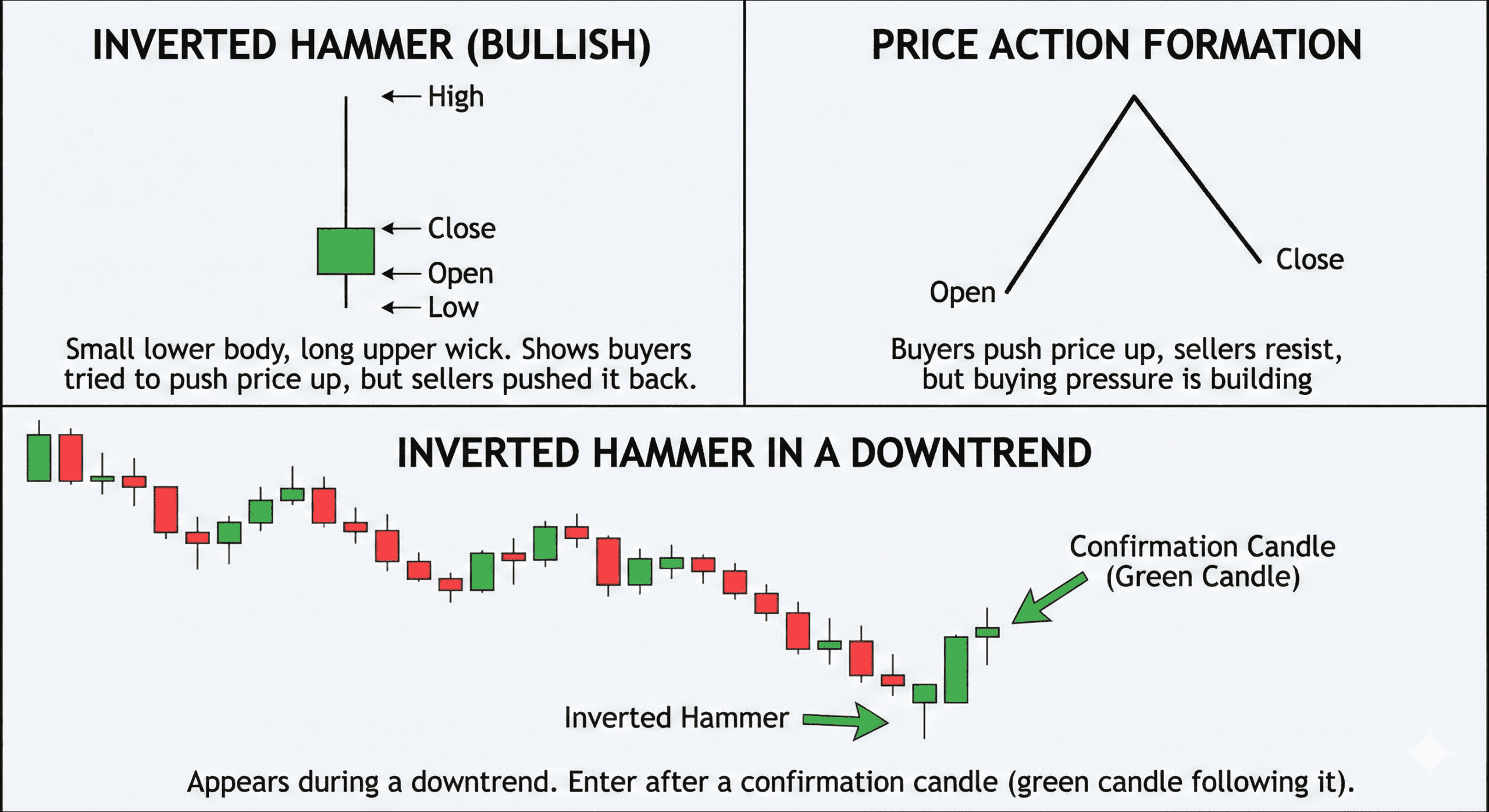
- How to trade it: Wait for confirmation (a green candle after it) before entering.
3. Bullish Engulfing (Bullish)
This is a two-candle pattern. A small red candle is followed by a massive green candle that completely “engulfs” the red one. It screams that buyers have taken total control.
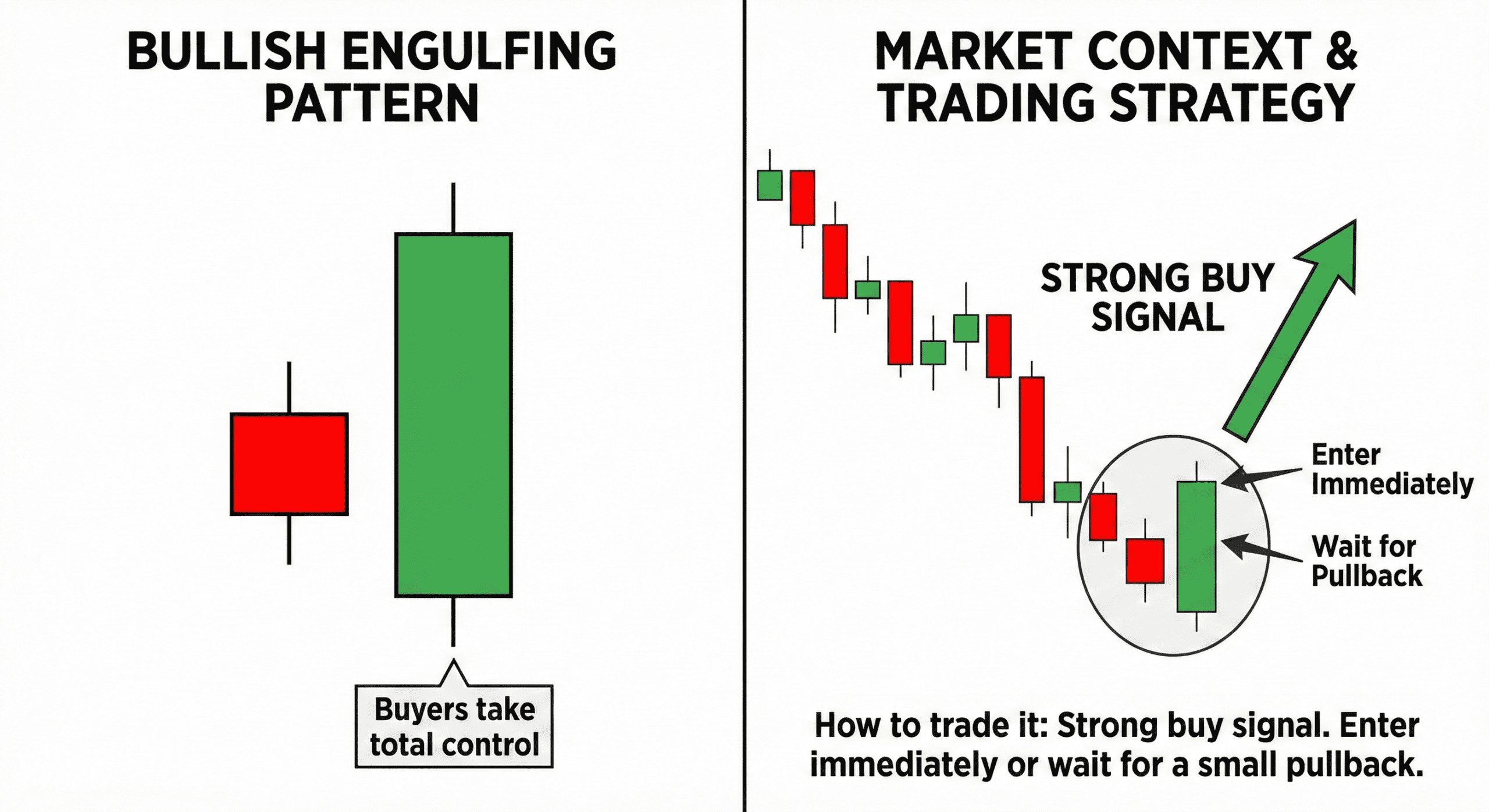
- How to trade it: This is a strong buy signal. Enter immediately or wait for a small pullback.
4. Bearish Engulfing (Bearish)
The opposite of the bullish engulfing. A small green candle is swallowed by a large red candle. This means the party is over, and sellers are dumping.
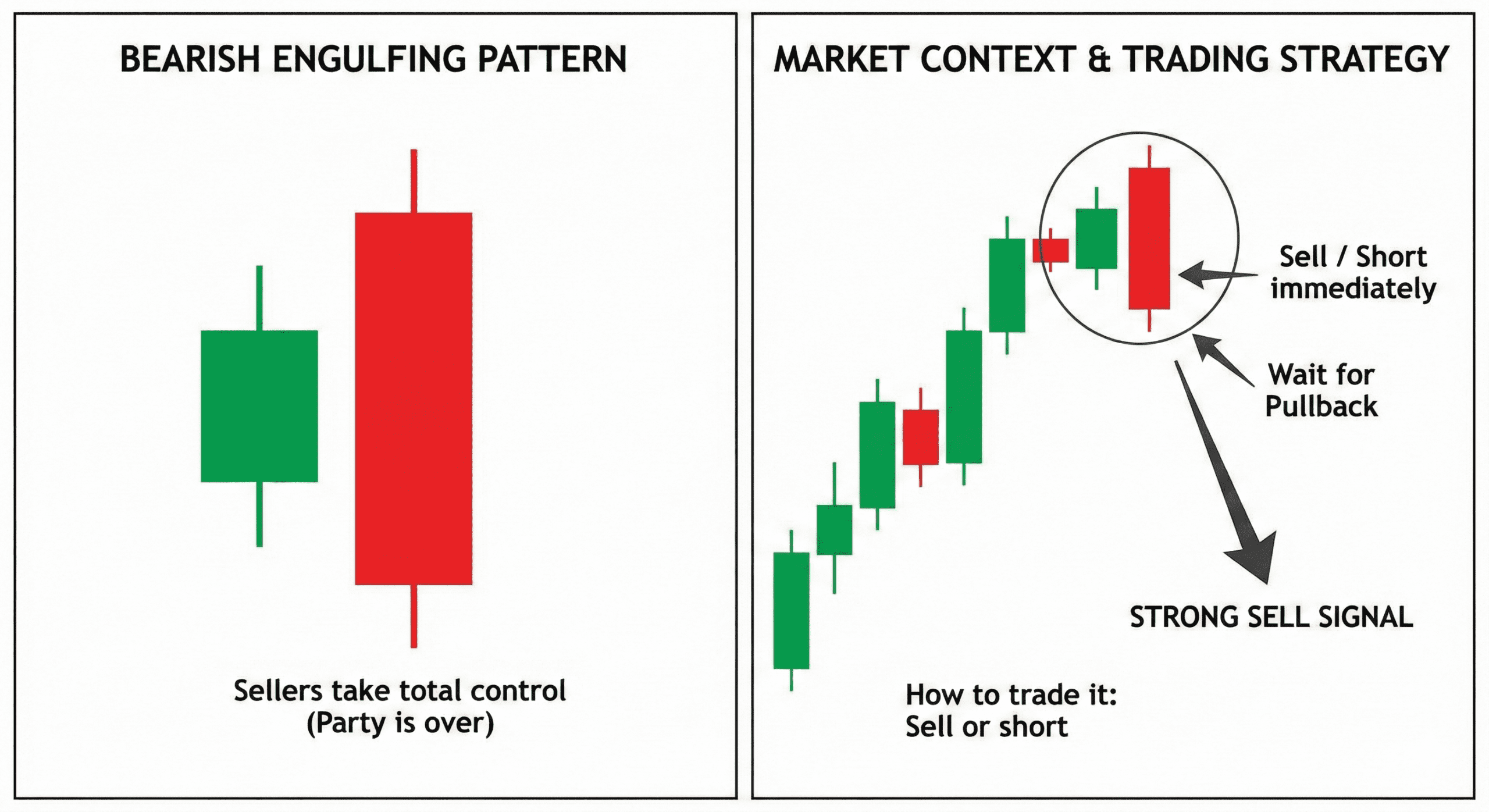
- How to trade it: Sell or short.
5. The Doji (Neutral/Indecision)
This candle has almost no body; it looks like a cross. The open and close prices are the same. It means buyers and sellers are fighting, but nobody won yet.
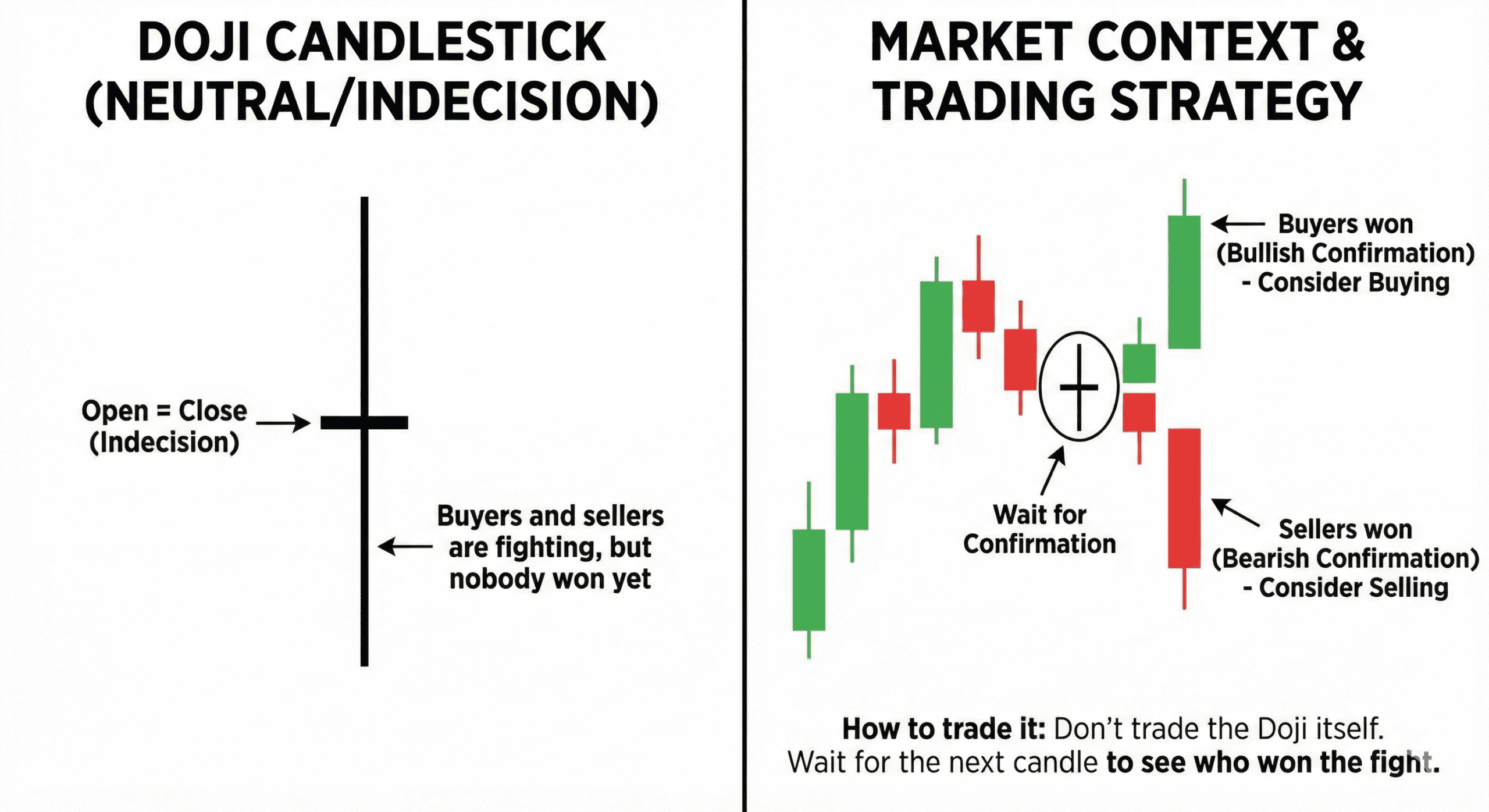
- How to trade it: Don’t trade the Doji itself. Wait for the next candle to see who won the fight.
6. Morning Star (Bullish)
A three-candle story. First, a big red candle (downtrend). Second, a small candle (indecision). Third, a big green candle (reversal). It’s like the sun rising after a dark night.
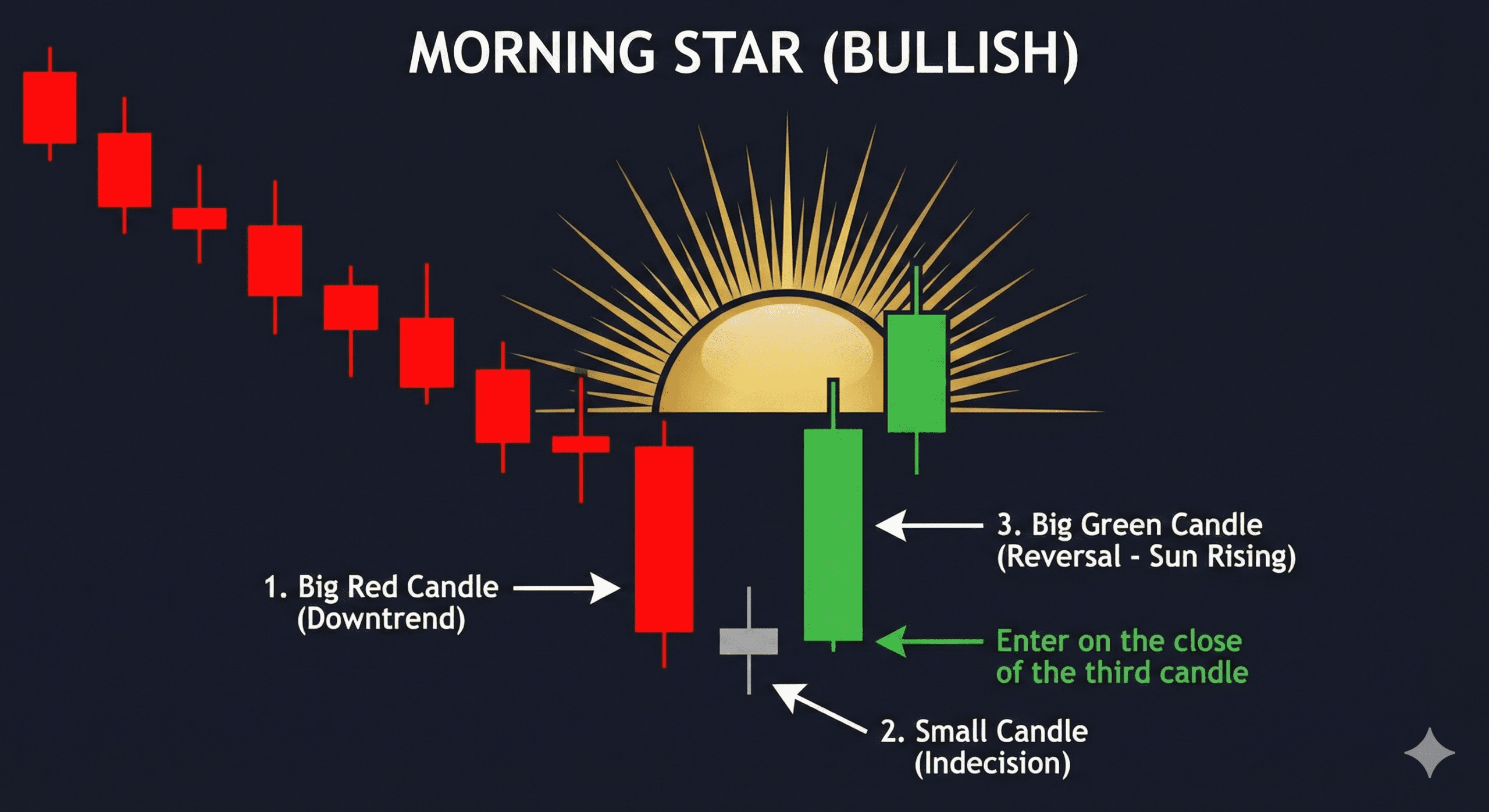
- How to trade it: Enter on the close of the third candle.
7. Evening Star (Bearish)
The opposite of the Morning Star. A big green candle, a small indecision candle, and then a big red candle. The sun is setting on the uptrend.
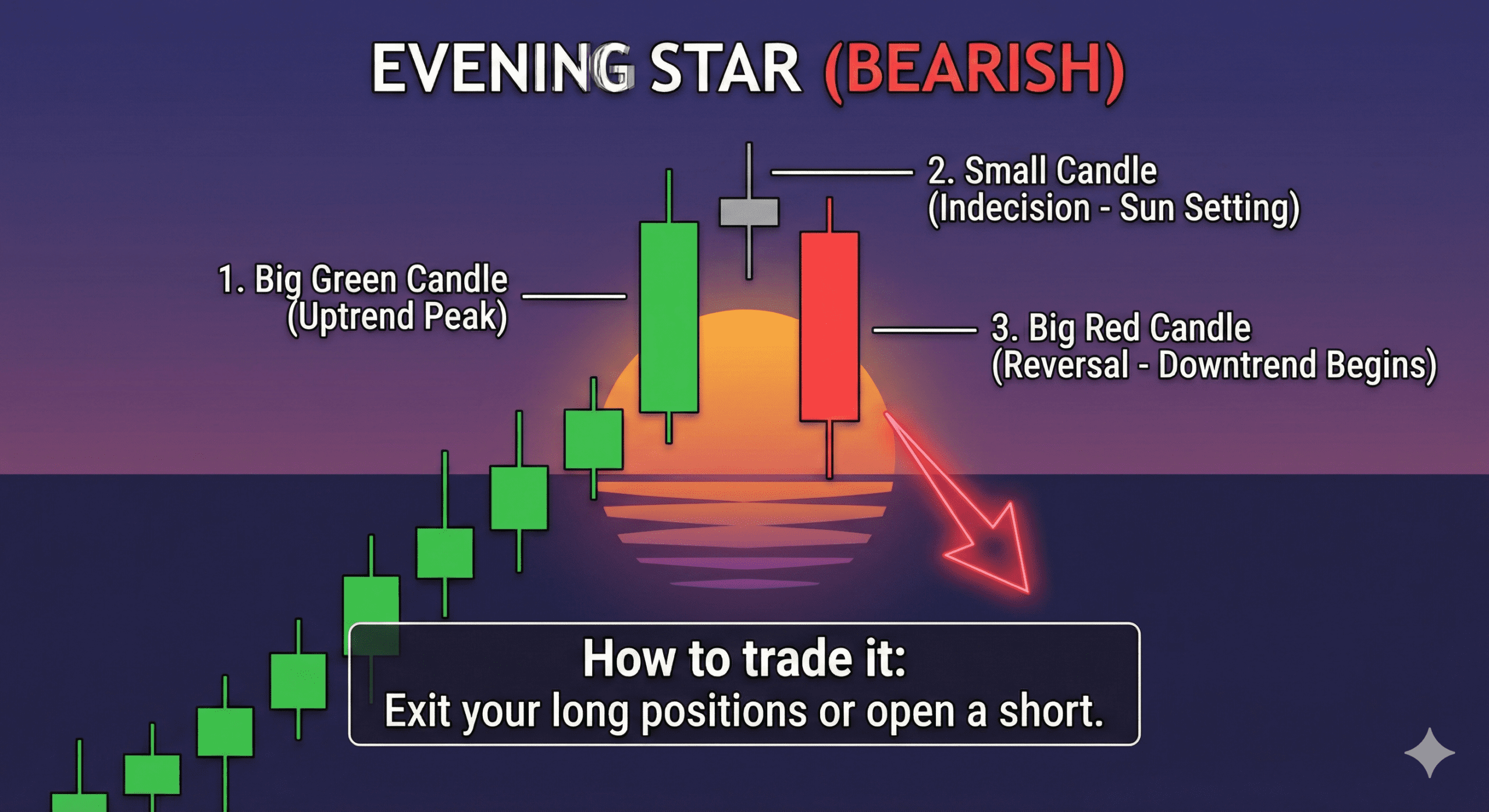
- How to trade it: Exit your long positions or open a short.
Major Market Patterns
Candles tell you what happened in minutes; Patterns tell you what is happening over days. Recognizing these is vital for any crypto trading for beginners guide.
1. Head and Shoulders (Bearish)
This looks like a person’s head and shoulders. A peak (left shoulder), a higher peak (head), and a lower peak (right shoulder). It signals the end of a Bull run.
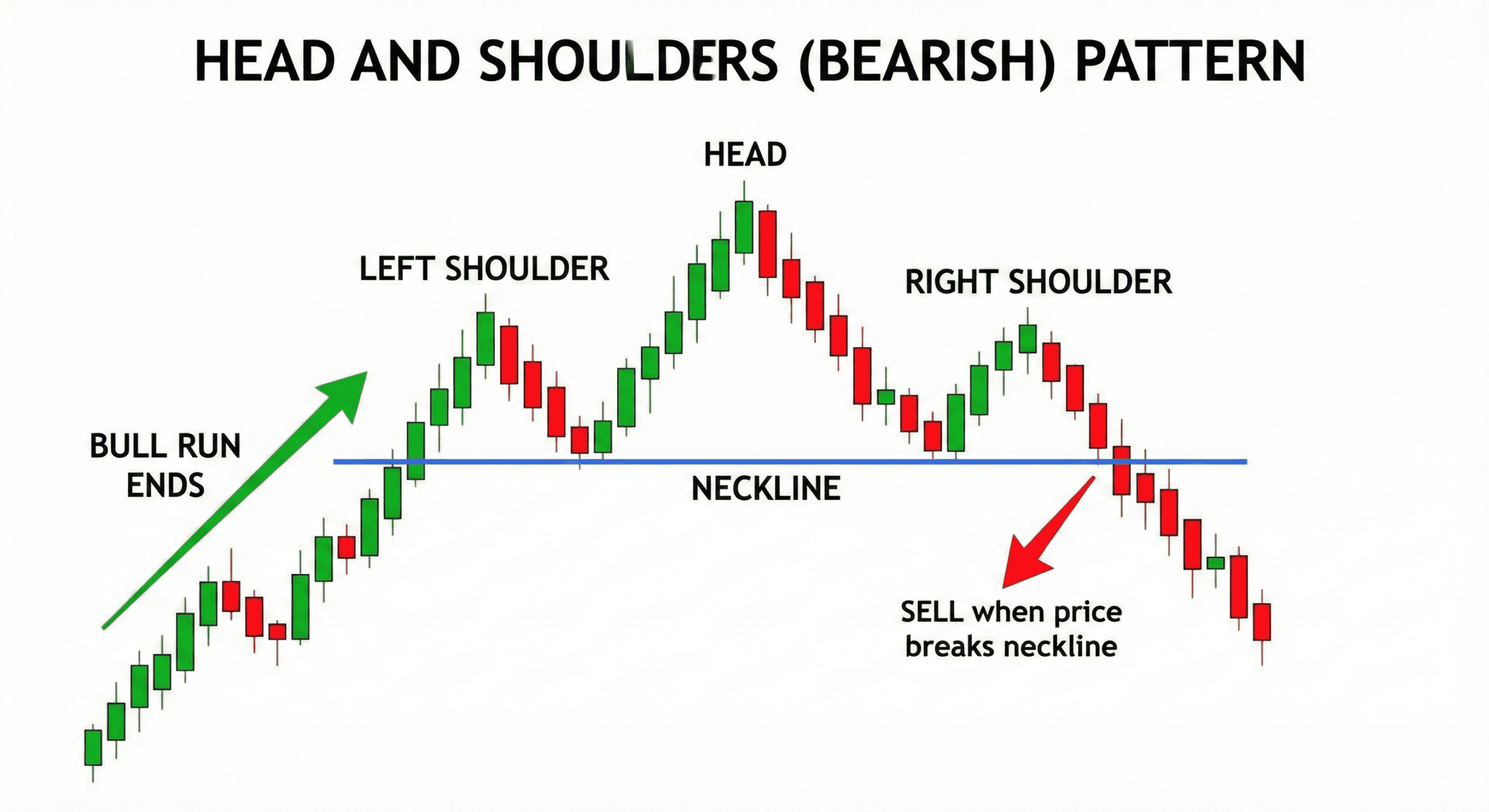
- The Neckline: The support line connecting the bottom of the shoulders.
- How to trade it: Sell when the price breaks the neckline downwards.
2. Inverse Head and Shoulders (Bullish)
The same pattern, but upside down. It signals the end of a Bear market.
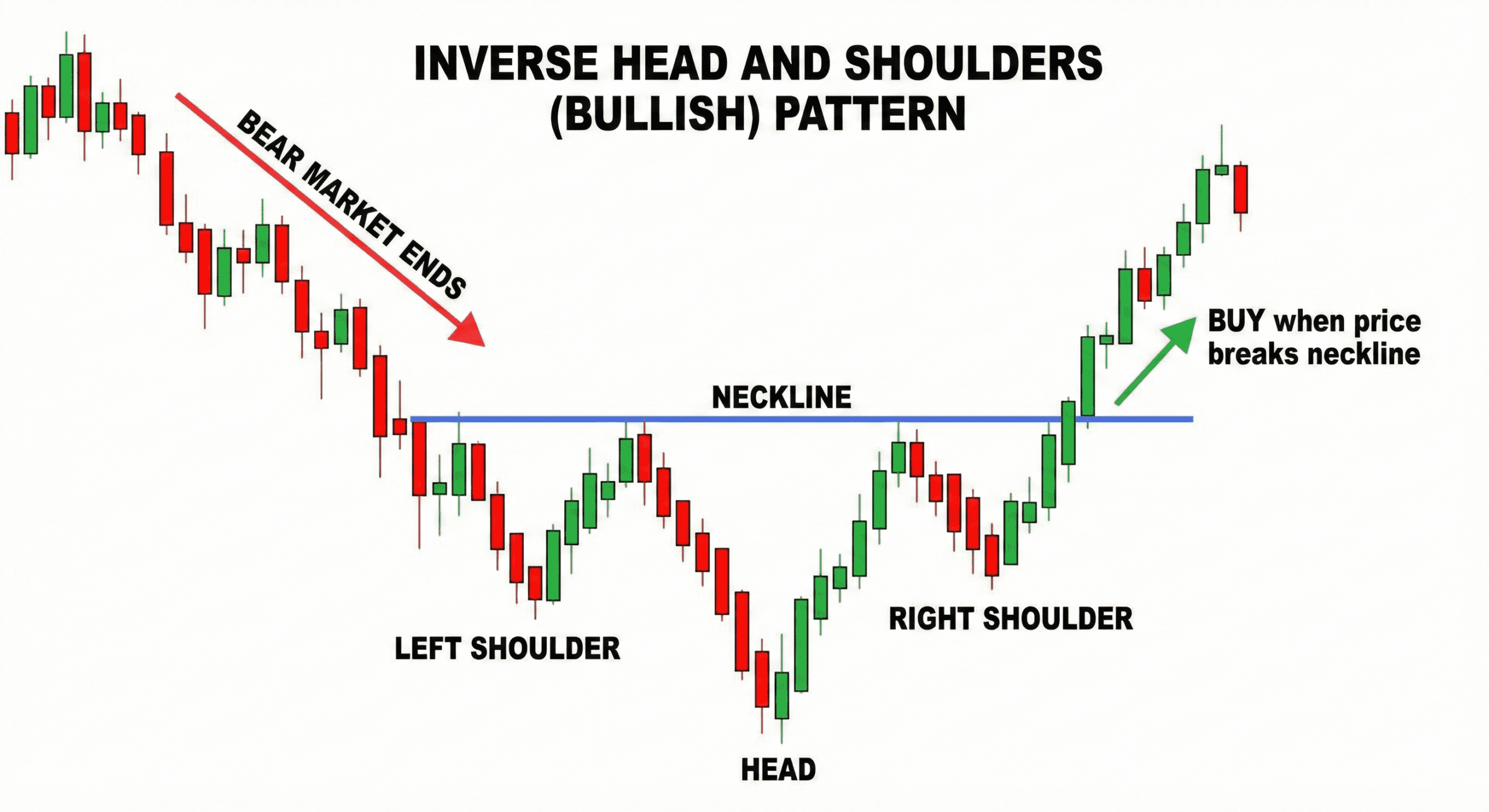
- How to trade it: Buy when the price breaks the neckline upwards.
3. Double Top (Bearish)
The price hits a high, drops, and hits that same high again, but can’t break through. It looks like an “M”. It means buyers are exhausted.
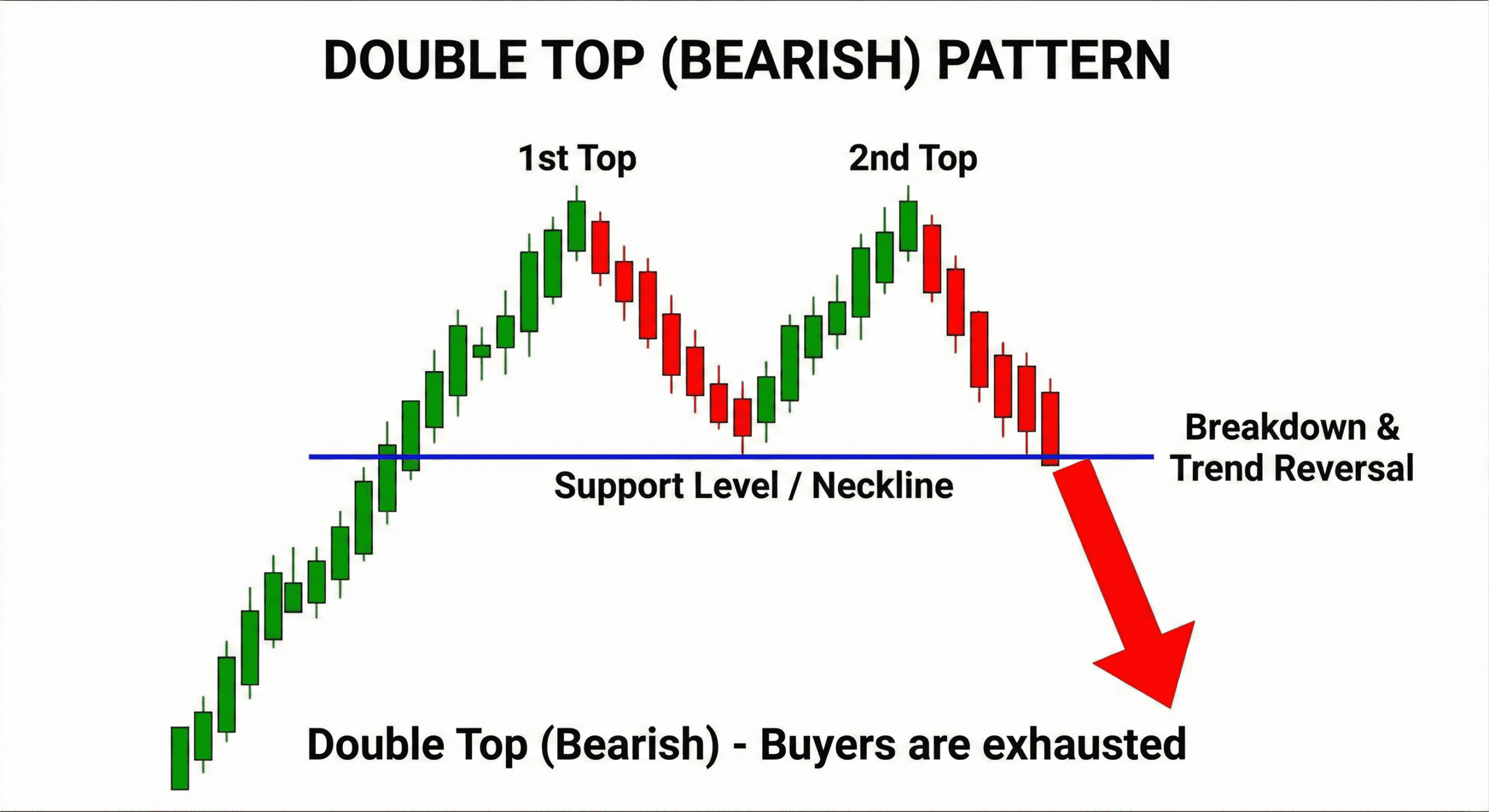
- How to trade it: Short when the price drops below the middle “valley” of the M.
4. Double Bottom (Bullish)
The price hits a low, bounces, hits that low again, and bounces. Looks like a “W”. It means the sellers gave up.
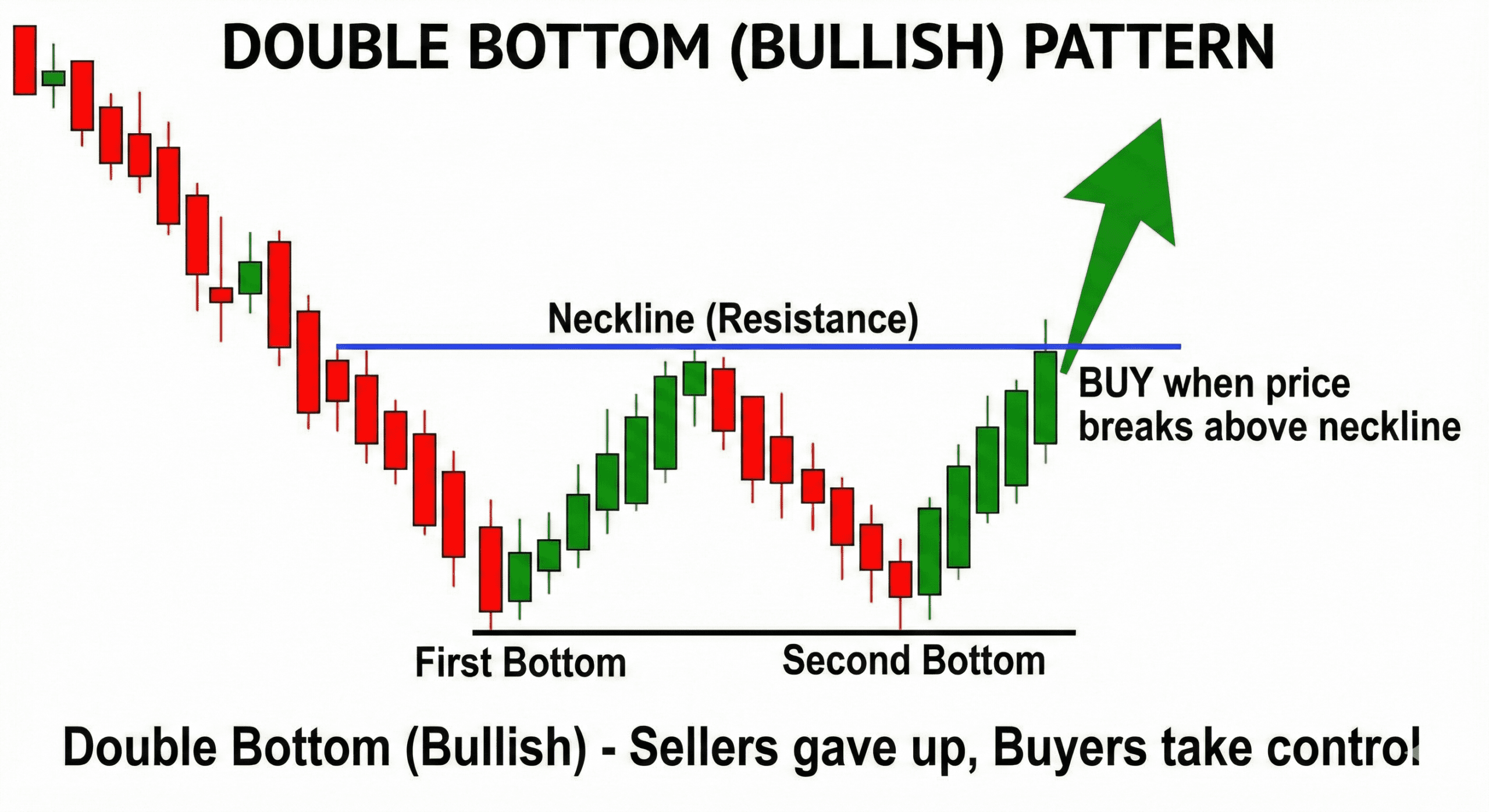
- How to trade it: Buy when the price breaks above the middle peak of the W.
5. Bull Flag (Bullish)
A sharp price rise (the pole) followed by a gentle downward sloping channel (the flag). It’s just the market taking a breath before running again.
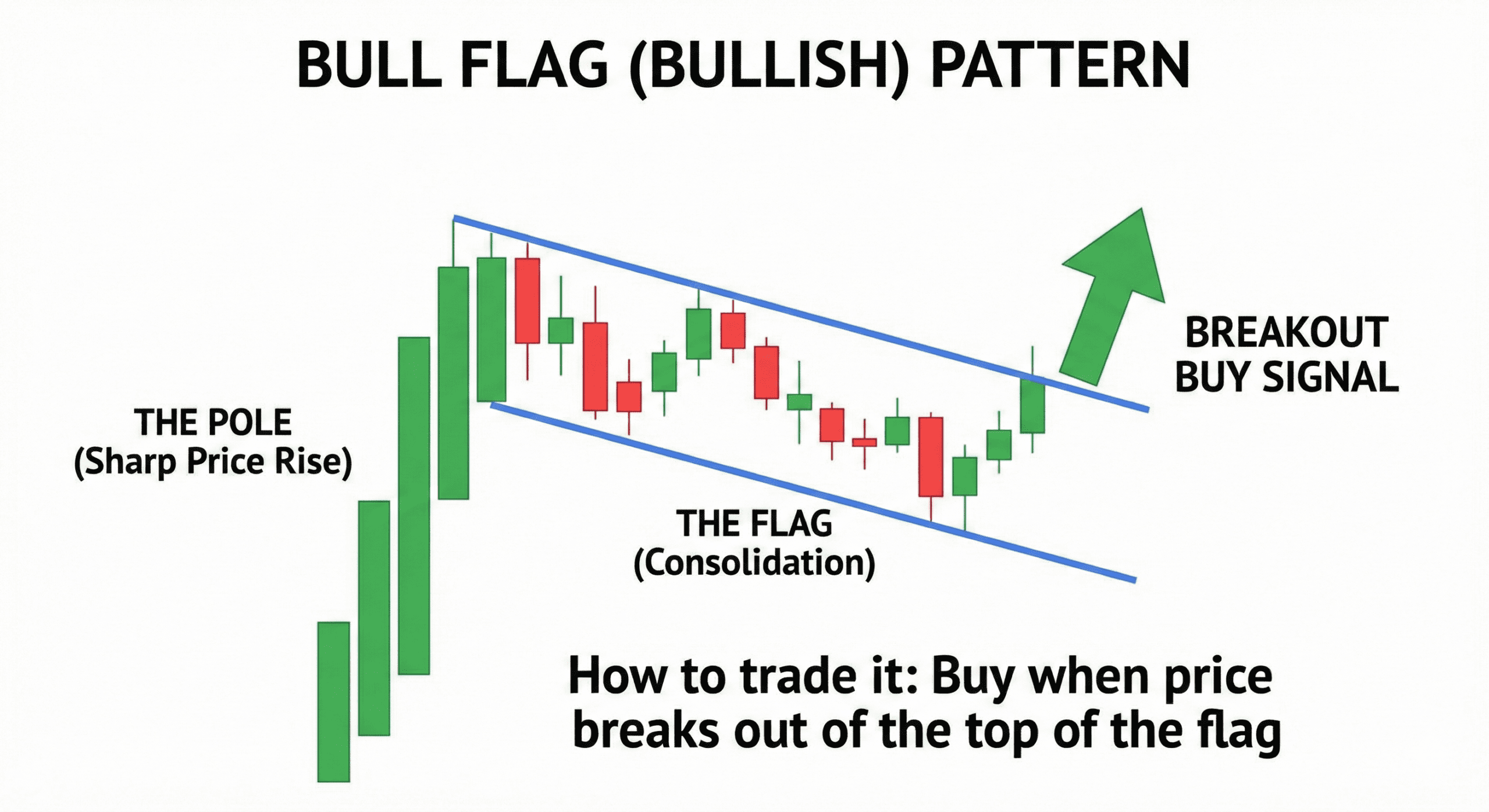
- How to trade it: Buy when the price breaks out of the top of the flag.
6. Bear Flag (Bearish)
A sharp drop followed by a gentle upward-sloping channel. It looks like a flag upside down.
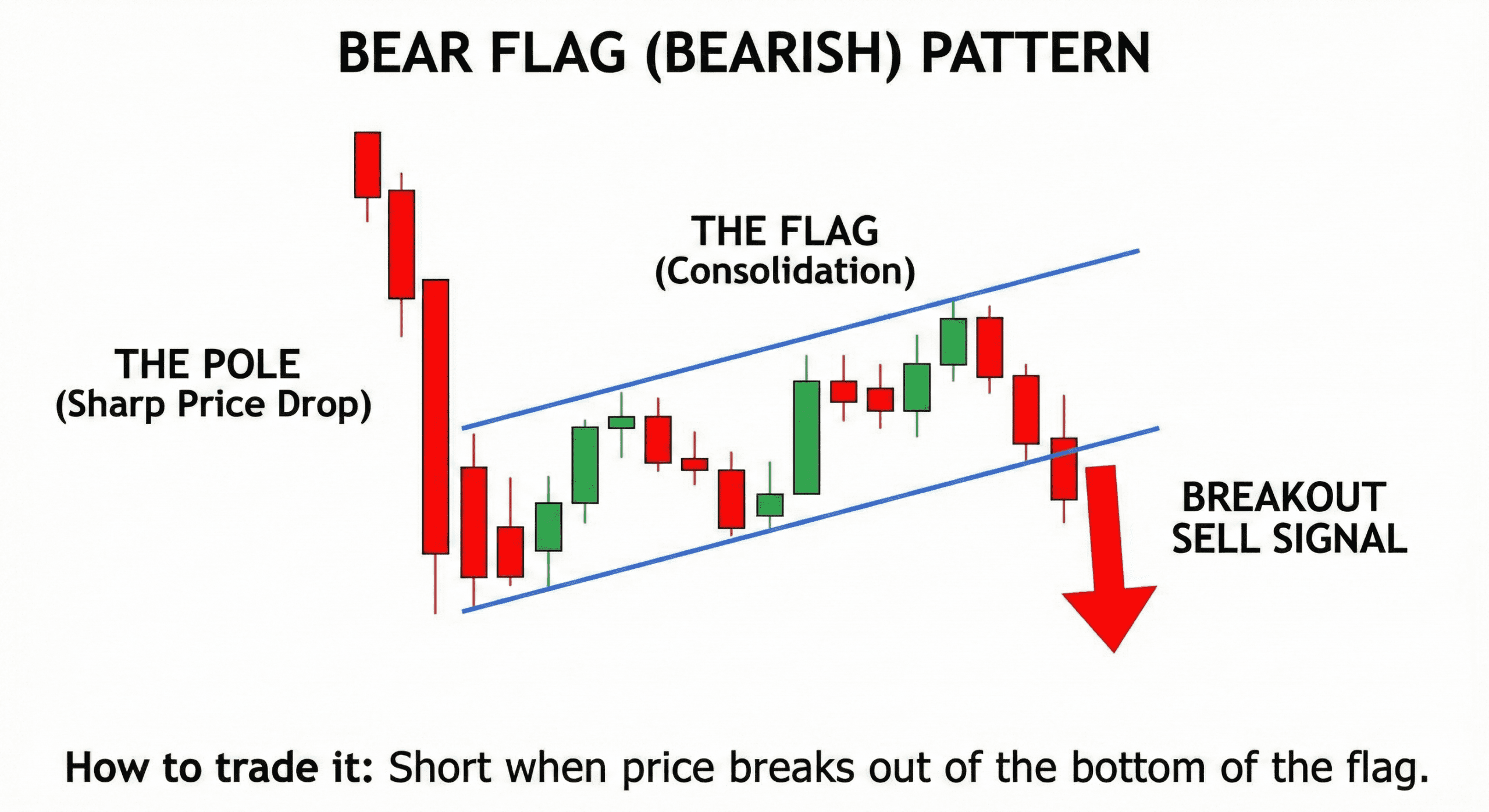
- How to trade it: Short when the price breaks out of the bottom of the flag.
7. Ascending Triangle (Bullish)
A flat resistance line on top and a rising support line on the bottom. Buyers are getting more aggressive, pushing the lows higher.
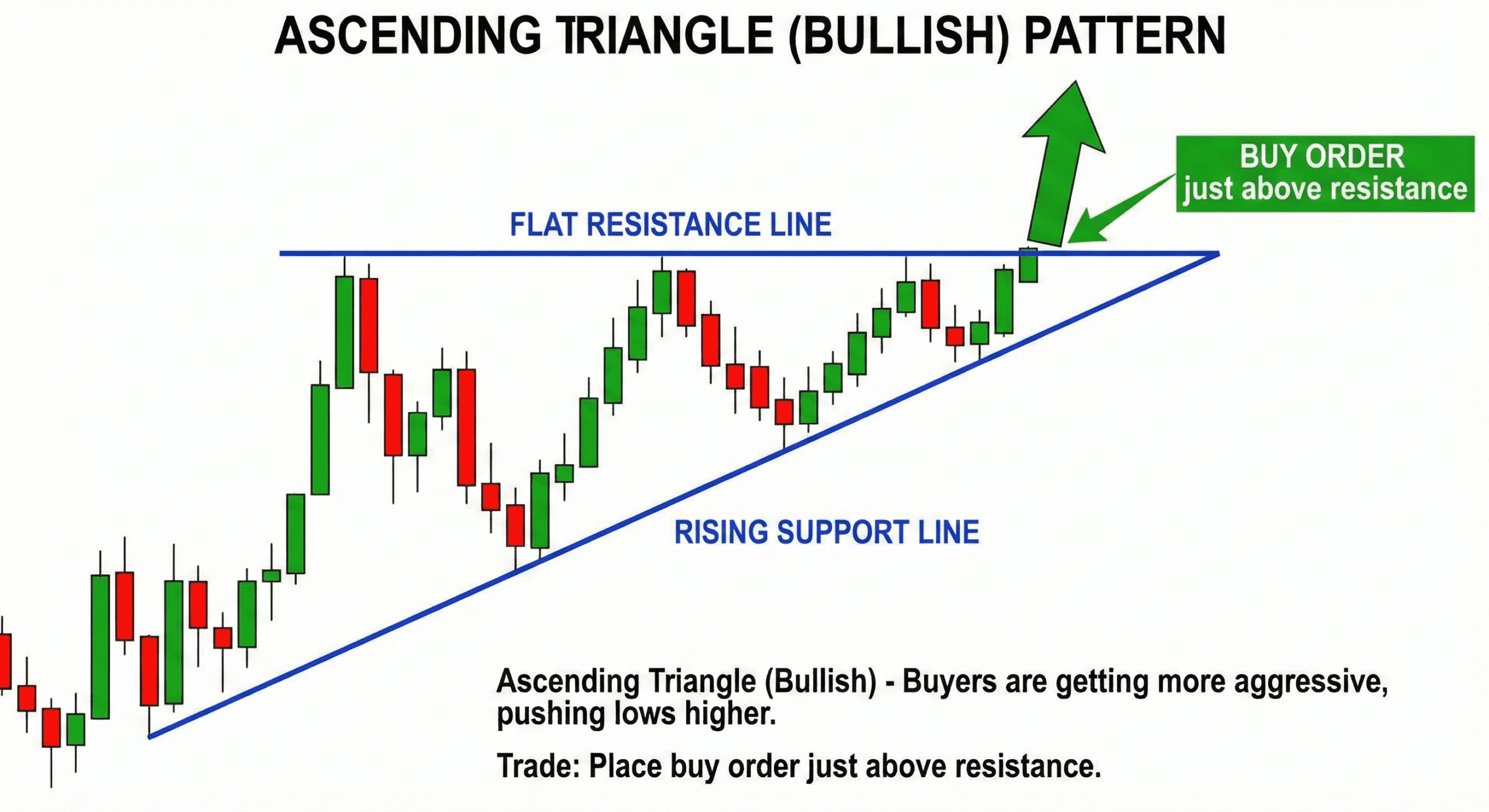
- How to trade it: Place a buy order just above the top resistance line.
8. Descending Triangle (Bearish)
A flat support line on the bottom and a falling resistance line on the top. Sellers are getting more aggressive.
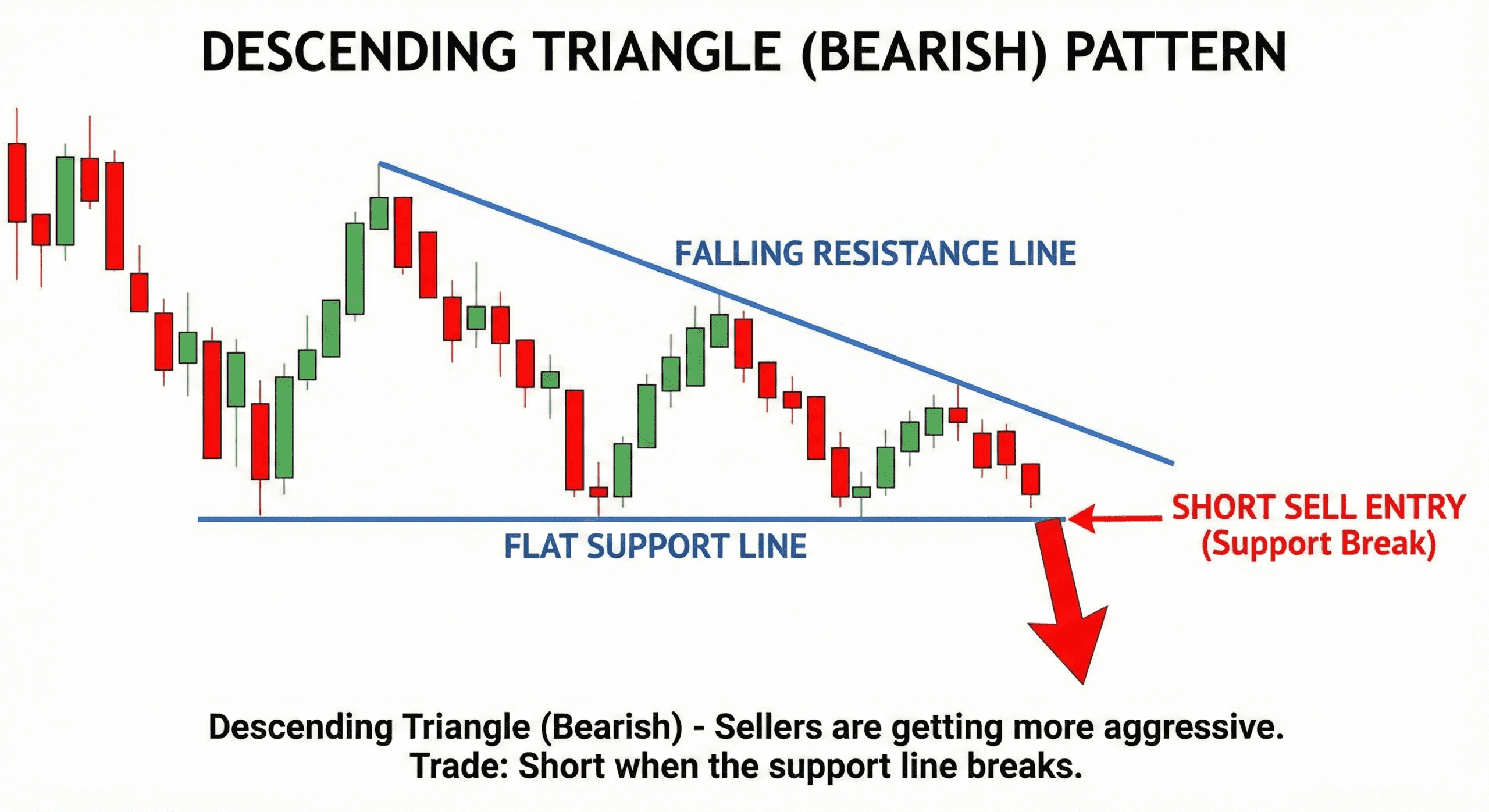
- How to trade it: Short when the support line breaks.
Note – Remember that correctly reading and implementing candlesticks or market patterns doesn’t mean guaranteed success, but along with other indicators, they help you provide a good entry or exit setup.
Part 4: Technical Indicators & Smart Money Concepts
You don’t need 50 indicators. You need the ones that work. We include these in this crypto trading for beginners guide because they are the industry standard.
RSI (Relative Strength Index)
This measures momentum.
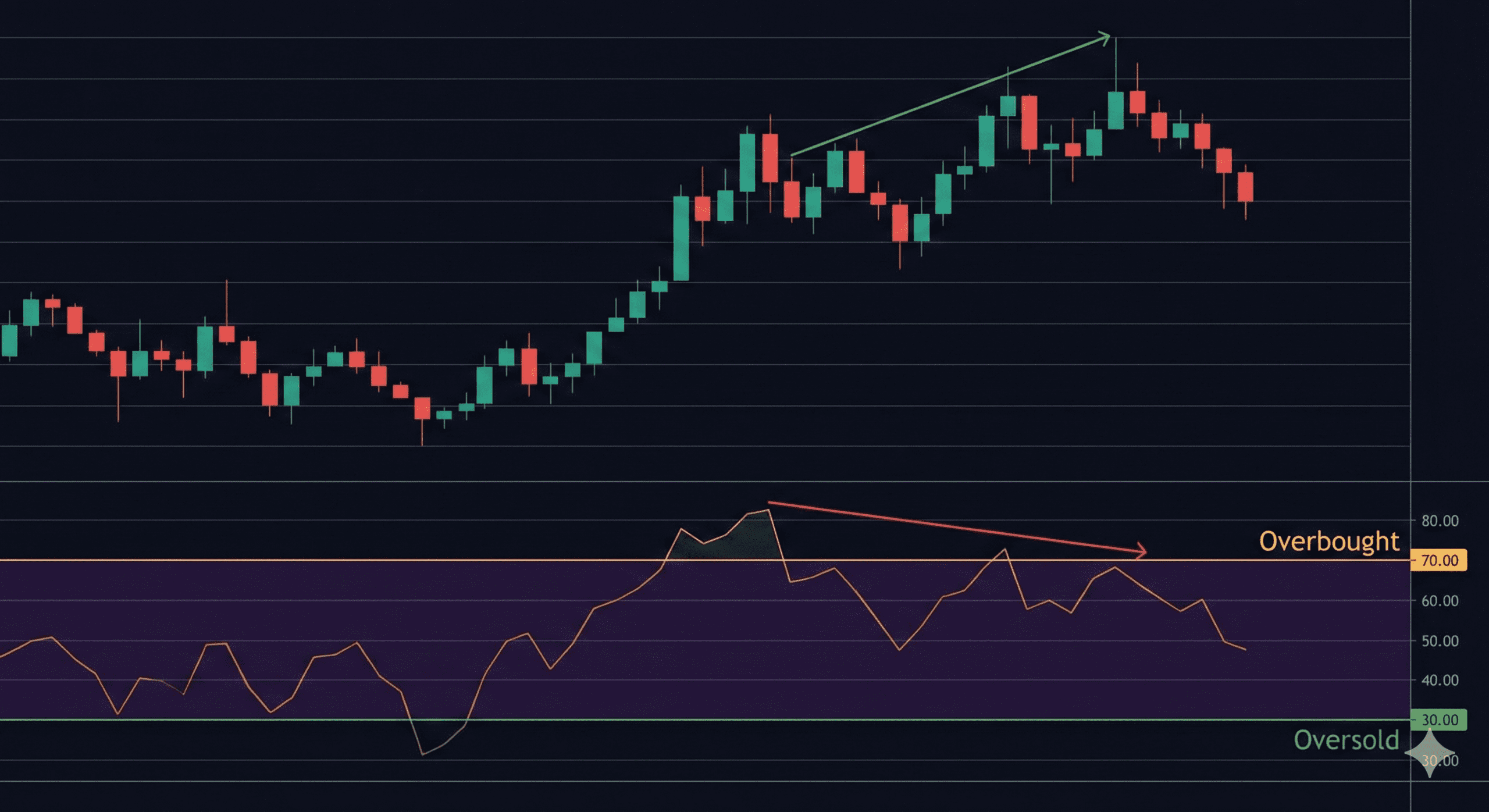
- Overbought (>70): The price rose too fast. It might drop soon.
- Oversold (<30): The price dropped too fast. It might bounce soon.
- Divergence: This is the secret sauce. If the price makes a Higher High, but the RSI makes a Lower High, the trend is weak. A crash is likely.
MACD (Moving Average Convergence Divergence)
This tracks the relationship between two moving averages.
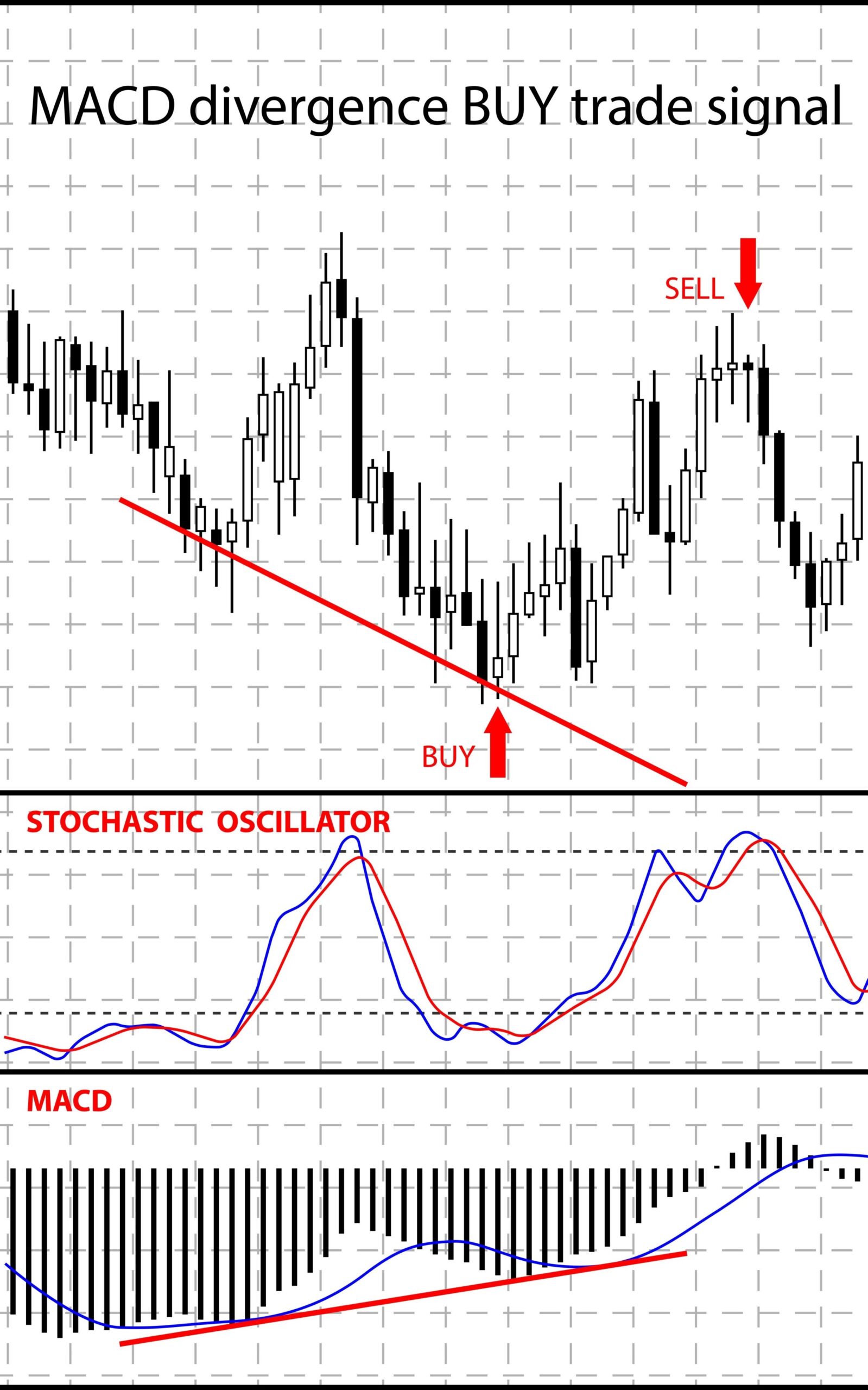
- Signal: When the Blue line crosses above the Orange line, it’s a Buy signal. When it crosses below, it’s a Sell signal.
Moving Averages (MA)
These smooth out the noise to show the true trend.
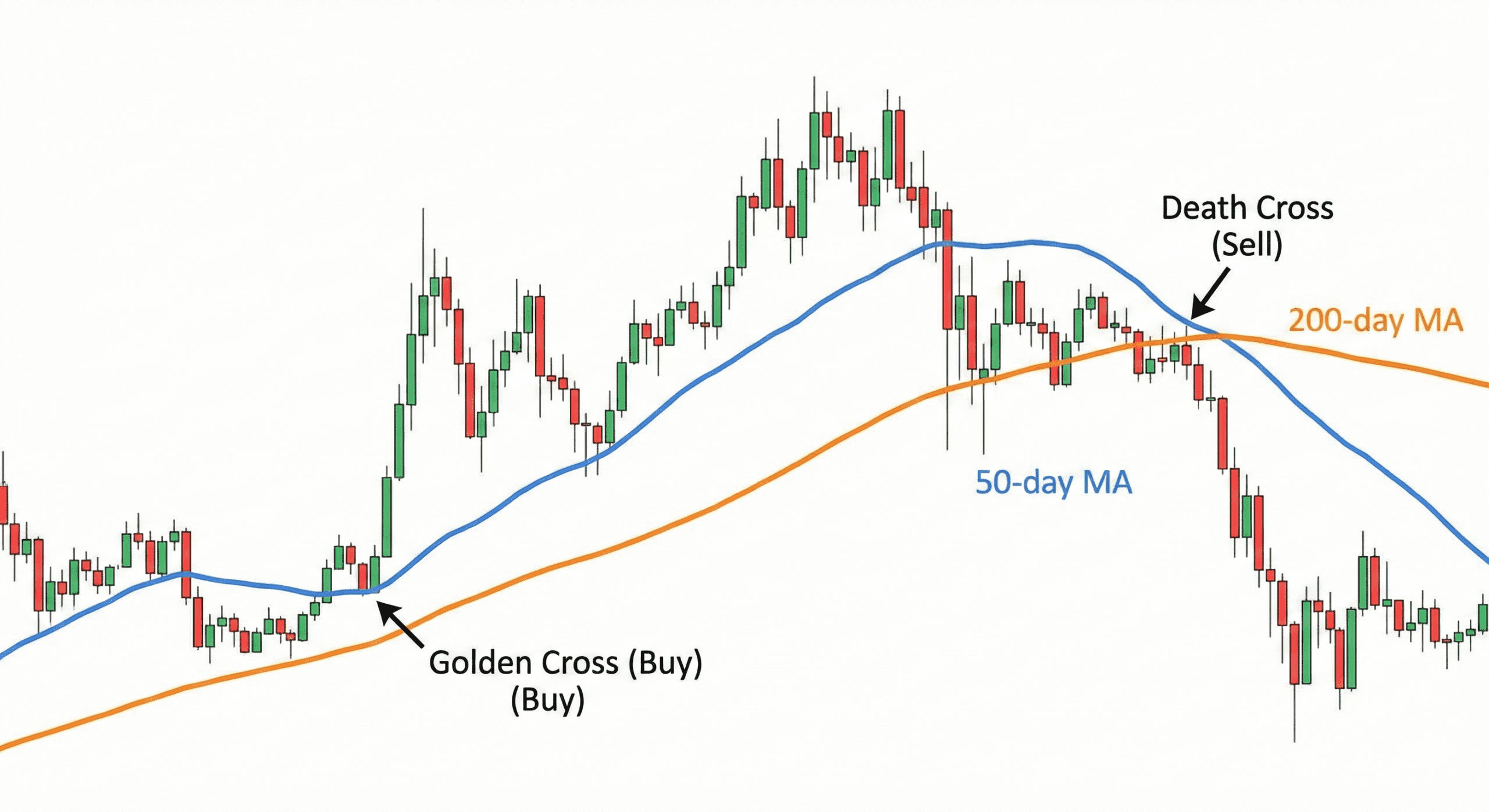
- Golden Cross: When the short-term average (50 MA) crosses above the long-term average (200 MA). This is a massive long-term buy signal.
- Death Cross: When the 50 MA crosses below the 200 MA. Massive sell signal.
Fibonacci Retracement
Prices never go up in a straight line. They move up, then pull back, then move up again. “Fibs” tell you where the pullback will stop.
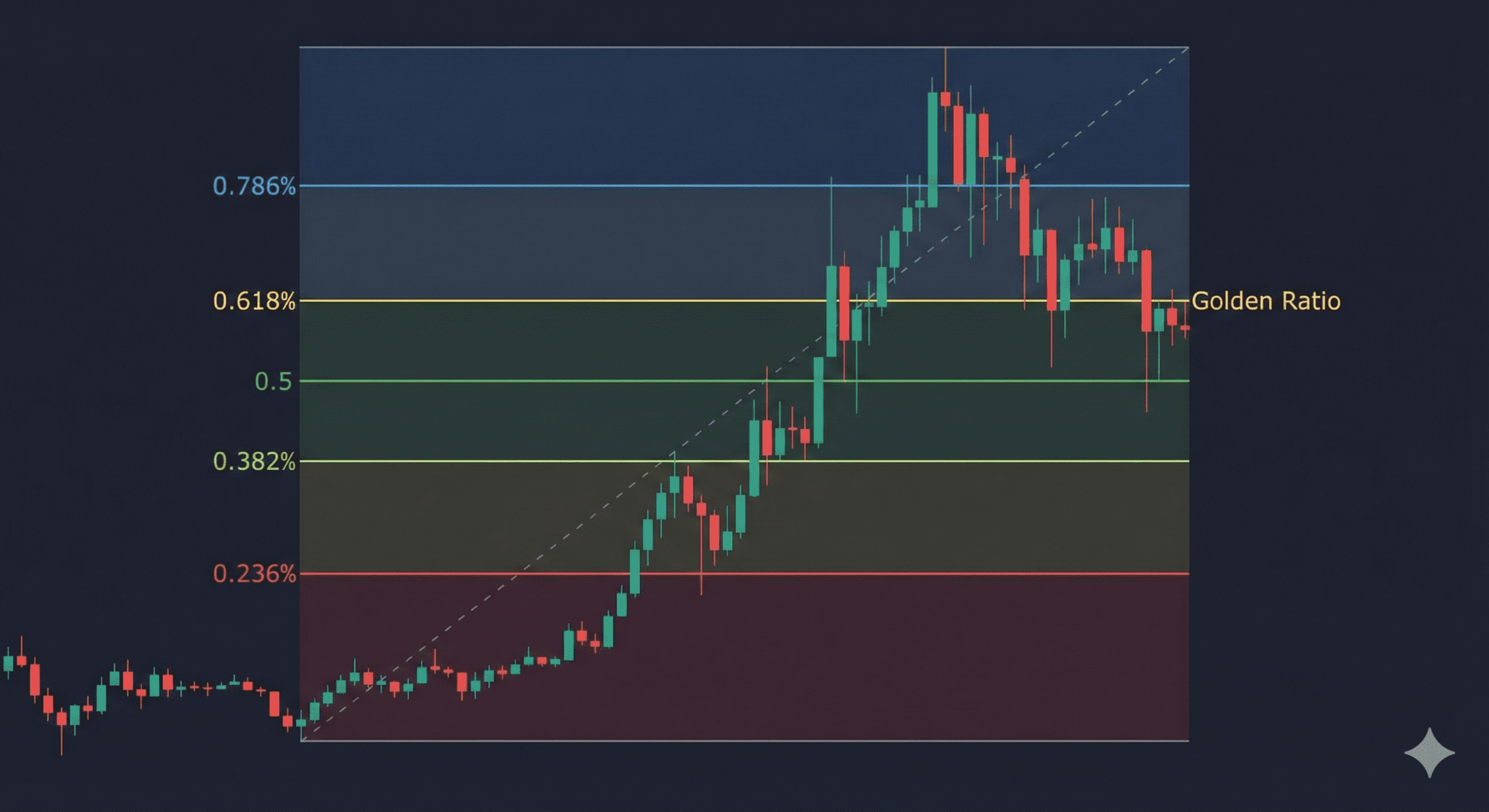
- Key Level: The 0.618 level (The Golden Ratio). Traders love to buy here during a pullback.
Smart Money Concepts (SMC) – The 2026 Meta
This is how the pros trade. It’s about following the “Whales.” It is an advanced topic often left out of basic crypto trading for beginners content, but it’s essential today.
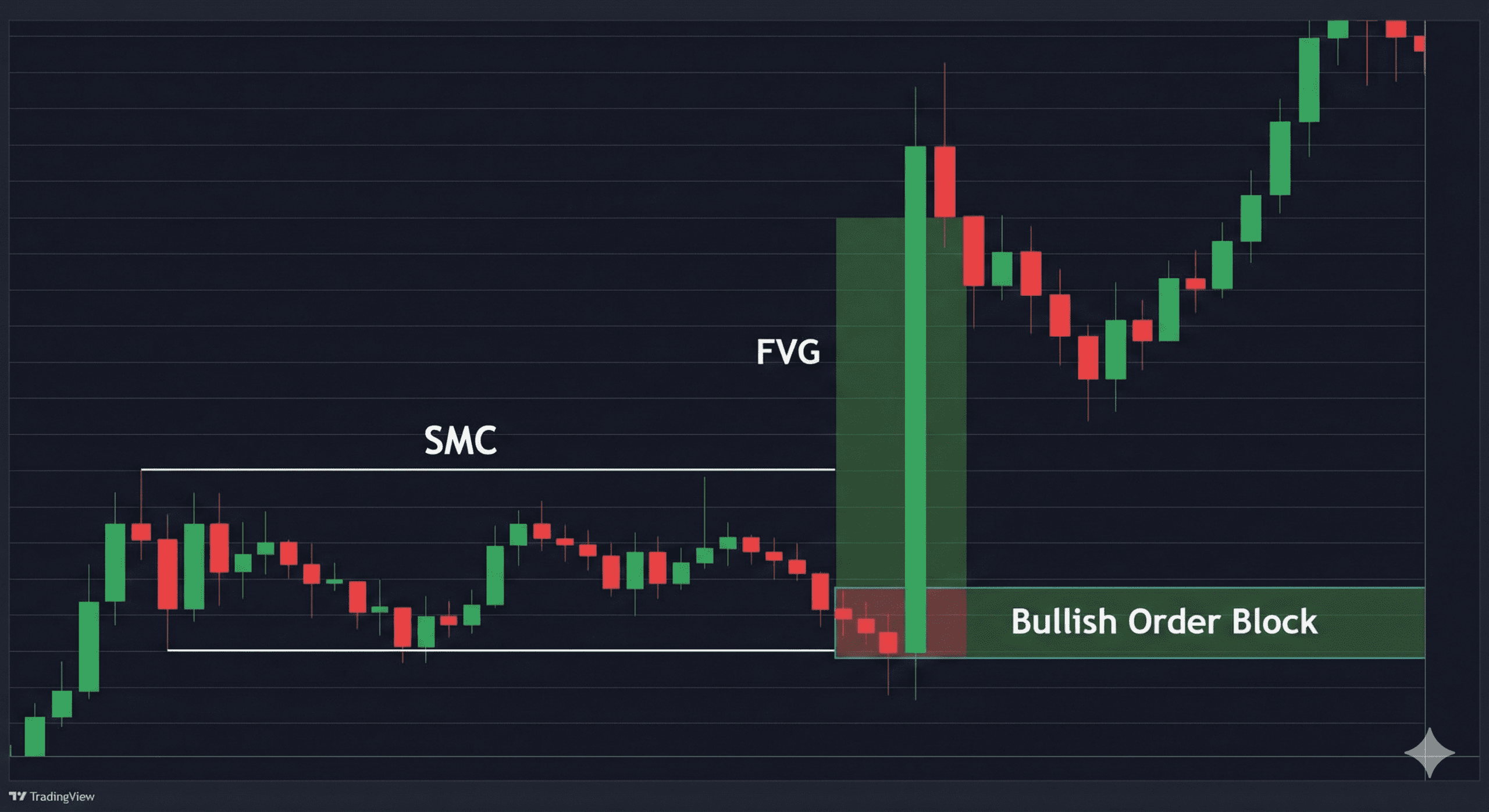
1. Fair Value Gap (FVG)
Imagine a massive green candle with no wicks on the side. It moved so fast that there were no orders filled in that area. The market hates gaps. It almost always comes back to fill this gap before continuing higher.
- Strategy: Don’t buy the pump. Wait for the price to drop back into the FVG, then buy.
2. Order Blocks
This is where the big institutions placed their orders. If you see a big move up, the last red candle before that move is the “Bullish Order Block.” When the price returns to this level, banks will defend it.
- Strategy: Place your buy orders at the top of the Order Block.
Part 5: Strategies – Choosing Your Weapon
You cannot be good at everything. Pick one style that fits your personality and schedule. This is essential for mastering crypto trading for beginners.
1. Day Trading (The Grinder)
- Timeframe: Minutes to Hours. You close all trades before you sleep.
- Goal: Capture small moves (2-5%) multiple times a day.
- Pros: No overnight risk (sleeping peacefully). Compounding gains quickly.
- Cons: Extremely stressful. Requires staring at screens all day. High fees.
- Best For: People with free time, high focus, and emotional control.
2. Swing Trading (The Strategist)
- Timeframe: Days to Weeks.
- Goal: Capture the “meat” of a trend (20-100%).
- Pros: Less screen time. You can have a day job. Bigger moves mean fees matter less.
- Cons: Overnight risk (waking up to a crash). Requires patience.
- Best For: Most beginners. It strikes the best balance in this crypto trading for beginners guide.
3. Scalping (The Speedster)
- Timeframe: Seconds to Minutes.
- Goal: Capture tiny moves (0.5% – 1%) with high leverage.
- Pros: Massive potential profit in short time. Action-packed.
- Cons: Highest risk of ruin. One bad trade can wipe out 10 good ones. You are competing with bots.
- Best For: Advanced traders with fast internet and nerves of steel.
4. Automated & Bot Trading (The Engineer)
- How it works: You set up a program (like a Grid Bot) to buy and sell for you based on rules. Platforms such as Cryptohopper let you run these strategies without coding.
- Grid Bot Example: In a sideways market, the bot buys every time the price drops 1% and sells every time it rises 1%.
- Pros: Removes emotion. Trades 24/7 while you sleep.
- Cons: Stupid in trending markets (can sell too early or buy a crashing coin).
- Best For: Tech-savvy users and passive income seekers who want beginner-friendly automation, like the built-in bots available on Pionex.
While executing trades manually helps build foundational market knowledge, staring at charts all day often leads to emotional fatigue and costly mistakes. To automate your strategy using pre-built DCA and grid algorithms without writing a single line of code, explore our guide to the 7 Best Crypto Trading Bots for Beginners in 2026 (No Coding Needed).
Note: You know, I’ve been working on something pretty special behind the scenes that I can finally share with you. Next month, I’m dropping a massive 5-hour trading masterclass right on the Coinexpansion YouTube channel. It’s not just boring theory, either; I’m going to walk you through two specific strategies and actually show you how they perform during live trading so you can see the real results.
But that’s not even the most exciting part. We are also getting ready to launch our very own Trading Bot platform. Imagine being able to automate your trades using over 100 ready-to-go strategies.
Part 6: Risk Management – How to Not Go Broke
This is the most boring section. It is also the only reason professional traders survive. Read this twice. It is the pillar of crypto trading for beginners.
The 1% Rule
Never risk more than 1-2% of your total trading capital on a single trade.
- Scenario: You have $10,000.
- You can risk: $100 per trade.
- This does not mean: You only buy $100 worth of Bitcoin. It means if your Stop-Loss hits, you only lose $100.
- Why? If you risk 1%, you can lose 10 trades in a row and still have 90% of your capital. If you risk 10%, 5 bad trades, and you are down 50%.
Risk/Reward Ratio (RRR)
Never take a trade unless the potential reward is at least 2x the risk.
- Bad Trade: Risking $100 to make $50 (0.5 RRR).
- Good Trade: Risking $100 to make $300 (3.0 RRR).
- The Magic: With a 3:1 RRR, you can be wrong 60% of the time and still make money. This simple math is the secret sauce of crypto trading for beginners.
Stop-Loss Placement
Where do you put your Stop-Loss?
- Wrong: “I’ll put it 5% down because that’s how much I want to lose.” The market doesn’t care about your wallet.
- Right: Put it below a technical Support level. If the price breaks support, your trade idea is invalid, so you should get out.
- Trailing Stop: As your trade goes into profit, move your Stop-Loss up. This guarantees you lock in profit even if the market reverses.
Diversification in Trading:
Don’t put your entire trading balance into one position.
- Have 3-5 active trades max.
- Don’t trade 5 coins in the same sector. If you are Long on 5 AI coins and the AI sector crashes, you lose everything. Mix it up: 1 Bitcoin, 1 Meme, 1 Layer-2, 1 RWA.
While understanding order types and chart patterns builds a solid foundation, surviving volatile market cycles requires strict execution discipline. To accelerate your learning curve and avoid high-cost beginner mistakes, explore our companion guide on actionable crypto trading tips for beginners.
Part 7: Trading Psychology – The Enemy Within
You can have the best strategy in the world, but if your mind is weak, you will lose. Trading is 10% skill and 90% psychology. This is often the hardest part of crypto trading for beginners.
FOMO (Fear Of Missing Out)
- The Feeling: You see a green candle shooting up. Everyone on Twitter is celebrating. You feel like an idiot for not being in. You buy at the top.
- The Reality: When it feels most comfortable to buy, it is usually the worst time.
- The Fix: If a coin has already pumped 50% in a day, you missed it. Let it go. Wait for a pullback. There is always another trade.
Revenge Trading
- The Feeling: You just lost $500 on a trade. You are angry. You want it back now. You immediately open a massive, high-leverage trade to “make it back.”
- The Result: You lose again. Now you are down $1,500.
- The Fix: If you lose 2 trades in a row, walk away. Close the laptop. Go to the gym. Come back tomorrow.
Building a Trading Plan
Before you click buy, write this down:
- Entry Price: $50,000
- Stop Loss: $48,500 (Why? Below support).
- Take Profit: $55,000 (Why? At resistance).
- Risk: $150 (1.5% of portfolio).
- Reason: RSI is oversold, price is at support, bullish news on Twitter.
If you can’t fill this out, do not trade. This discipline is the core of our crypto trading for beginners guide.
Journaling
Every weekend, review your trades.
- “Why did I win this trade?” (Was it skill or luck?)
- “Why did I lose this trade?” (Did I break my rules? Was I emotional?) You will find patterns. “I always lose money when I trade on Friday afternoons.” -> Stop trading on Fridays.
Part 8: The 2026 Toolkit & Resources
To survive in 2026, you need the modern stack.
Charting & Data:
- TradingView: Essential for charts.
- CoinGlass: Essential for derivatives data (Liquidations, Funding Rates, Open Interest).
- DexScreener: Best for finding new, low-cap coins on DEXs.
Research:
- Messari: Professional-grade research reports.
- Token Unlocks: Tracks vesting schedules.
- CryptoQuant: On-chain analytics.
Security:
- Hardware Wallets: For the highest level of security, compare the best crypto hardware wallets, such as Trezor Safe 3 or Ledger Flex.
- MetaMask Wallet: Secure and best desktop wallet
While exchange wallets are convenient for active daily trading, leaving significant profits online exposes you to unnecessary third-party risk. To secure your long-term portfolio completely offline, compare today’s top-tier hardware solutions by reading our in-depth Trezor Safe 3 Review 2026: Is It Better Than the Model One? and our comprehensive Ledger Cold Wallet Review 2026: Is It Still the Ultimate Vault?.
Part 9: Conclusion & Next Steps
You now possess the roadmap. You understand the difference between a market order and a limit order. You know why leveraging 100x is suicide. You know that a Head and Shoulders pattern means “sell.” This crypto trading for beginners guide was designed to give you a fighting chance.
But reading a guide doesn’t make you a soldier; only the battlefield does.
Your Next Step: Don’t deposit your life savings today.
- Open a Paper Trading Account on TradingView or Bybit. This lets you trade with fake money.
- Turn $10,000 of fake money into $11,000.
- If you can’t make money with fake money, you won’t make it with real money.
- Once you are profitable for 1 month, deposit a small amount ($500).
The market will be here in 2027. The goal isn’t to get rich this month. The goal is to survive this month so you can get rich this decade.
Good luck. Stay liquid.
While keeping funds on an active exchange provides liquidity for daily trades, storing your long-term profits offline is the only way to eliminate third-party risk. To evaluate industry leaders like Ledger, Trezor, and Tangem, read our complete 5 Best Hardware Wallets 2026 comparison to find the right cold storage solution for your portfolio.
Maximize Your Edge: Join Our Live Trading Community
Reading this handbook gives you the theoretical blueprint, but mastering market dynamics requires real-time feedback and continuous learning. Markets evolve rapidly, and staying ahead of liquidity shifts or news catalysts is easier when analyzing charts alongside experienced traders.
Join Our Crypto Expansion Community Now to connect with thousands of active retail traders. Access weekly market breakdowns, share live chart setups, discuss risk management strategies, and get real-time feedback on your trading journal in a clean, hype-free environment built for disciplined growth.
1. How do I start crypto trading as a beginner?
Start by choosing a reputable exchange (like Binance, Bybit, or Delta Exchange (Indian only)), completing your KYC verification, and depositing a small amount of funds. We recommend practicing with a demo account first.
2. Can I trade crypto with $100?
Yes. In fact, starting small is recommended for crypto trading for beginners. It allows you to learn the mechanics without risking significant capital.
3. Is crypto trading safe for beginners?
This is the whole purpose of this crypto trading for beginners’ guide. To make it simple for you. However, trading carries high risk due to volatility. However, if you stick to major exchanges, practice with demo trading, learn charts and indicators, avoid high leverage, and apply risk management while real money trading, you can manage these risks effectively.
5. What is the difference between trading and investing?
Trading involves frequent buying and selling to profit from short-term price changes, while investing involves holding assets for the long term (HODLing). If that matches your goals, check our best cryptocurrencies for long-term investing guide.
6. How much money do I need to start trading crypto?
You can start with as little as $10-$50 on most exchanges. However, to see meaningful returns from strategies like swing trading, a capital of $500-$1,000 is often recommended.
7. Is crypto trading taxable?
Yes, in most countries (including the US, UK, and India), profits from crypto trading are subject to Capital Gains Tax. Always check your local regulations.
8. Can you make a career by trading crypto?
Yes, of course. But most beginners lose money initially. Success requires study, discipline, and risk management, key themes of this crypto trading for beginners guide.
10. How do I choose a crypto wallet?
For trading, use a “hot wallet” or exchange wallet. For long-term storage, use a “cold wallet” (hardware wallet) like a Ledger or Trezor for maximum security.