What Really Determines Bitcoin Value And Price? An Incredible In-Depth Guide (2026-2030)
When analyzing the cryptocurrency market, it is essential to understand that the bitcoin value and price are influenced by two completely different economic drivers. As we stand in late 2025, watching Bitcoin trade at levels that were once considered fantasy, the question remains: Why? Is it just hype, or is there a fundamental engine driving this asset? To understand where Bitcoin is going—and whether the prediction of it hitting $1 million by 2030 is realistic—we must first understand what gives it value in the first place.
This guide covers the fundamental economics of Bitcoin price and value, analyzes its volatile history, and offers a data-backed Bitcoin price prediction through 2030.
When evaluating the cryptocurrency market, understanding the macroeconomic factors that drive Bitcoin Value And Price is essential for long-term investors.
Many retail traders fall into the trap of analyzing short-term charts without looking at the fundamental laws of supply and demand that govern Bitcoin Value And Price.

How We Selected the Platforms for This Analysis
To ensure our historical analysis and future predictions remain objective, we relied on a strict vetting process for the platforms and data sources used to build this guide. Here is how we selected them:
- Data Aggregation Platforms: We prioritized platforms that provide unmanipulated, real-time volume metrics and order book depth across multiple top-tier centralized exchanges to avoid localized price anomalies.
- On-Chain Analytics: We selected on-chain tracking platforms based on their ability to accurately filter out internal exchange transfers and isolate genuine institutional inflows, miner sell-offs, and whale accumulation metrics.
- Forecasting Models: Rather than relying on sentiment-based platforms, we selected data platforms that utilize mathematical models (like the Stock-to-Flow model and logarithmic growth curves) because they historically align with Bitcoin’s programmatic halving cycles.
- Macroeconomic Tracking: We monitor platforms that directly track spot ETF inflows, Federal Reserve interest rate policies, and sovereign wealth fund allocations, as these institutional platforms are the primary drivers of the current “Sovereign Era.”
As spot ETFs continue to gain massive institutional traction, the correlation between global liquidity and Bitcoin Value And Price becomes increasingly clearer.
To successfully navigate periods of deep market consolidation, an investor must look beyond temporary sentiment and study the intrinsic drivers of Bitcoin Value And Price.
🔑 Key Takeaways
To summarize the core concepts of this Bitcoin price and value guide:
- Scarcity is King: The hard cap of 21 million coins ensures Bitcoin can never be inflated like fiat currency. This digital scarcity is the foundation of its value.
- Price ≠ Value: Price is the momentary dollar amount determined by trading, while value is the long-term utility (censorship resistance, borderless transfer) of the network.
- The Halving Cycle: Bitcoin moves in 4-year cycles driven by supply cuts (halvings). The next major supply shock is in 2028.
- Institutional Adoption: The era of “magic internet money” is over. With ETFs and sovereign nations buying in, the price floor has risen permanently.
- 2030 Outlook: Data models suggest a price target between $500,000 and $1 million by 2030, assuming Bitcoin continues to eat into Gold’s market share.
Part 1: Bitcoin Value and Price (The Fundamentals)

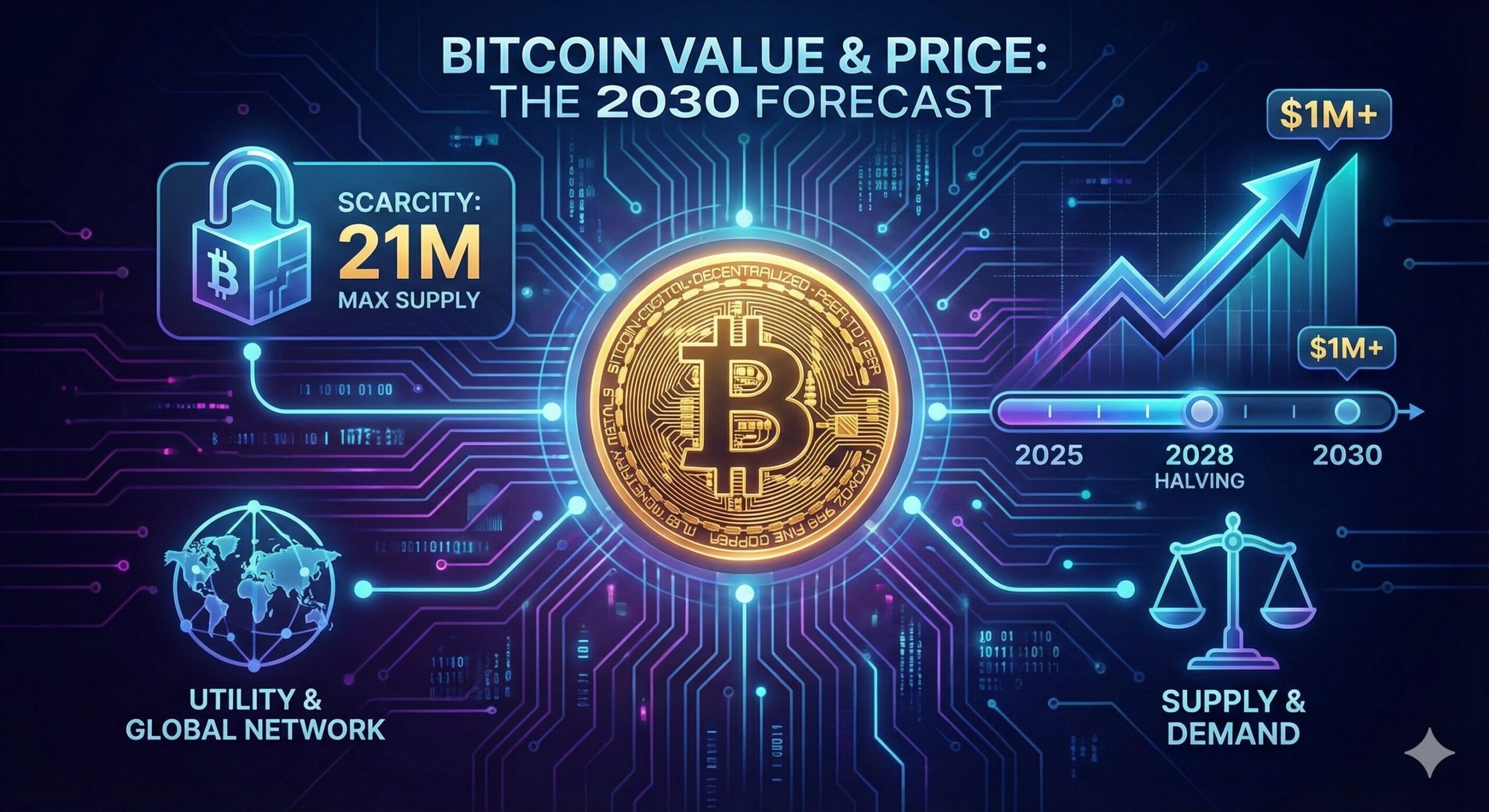
The answer to the question “what determines Bitcoin value and price?” is rather simple, and it lies in basic economics: scarcity, utility, supply, and demand.
Most people still view digital currency as “magic internet money,” but its valuation follows the same principles as tangible assets. Take the example of the diamond. A diamond is valuable because it is rare (scarcity), hard to find, and limited in supply. Diamonds also have some uses from which consumers derive satisfaction (utility), such as in jewelry or industrial cutting tools. The same is true for Bitcoin and altcoins.
Here is the breakdown of the factors influencing Bitcoin value and price:
1. Scarcity: The Digital Gold Standard
Bitcoin and altcoins are limited in supply, like Gold. Most people still have a difficult time understanding what drives Bitcoin’s value and price. A good way to look at it is to compare it to gold.
Just like gold, cryptocurrencies have a limited supply. The total number of Bitcoins that will ever be produced is set at 21,000,000 coins. Although it might not sound like much, it’s quite enough. But Bitcoin currency will not reach infinity, so it is scarce in a sense. The same is true for other top cryptocurrencies.
To date, there are over 19 million Bitcoins mined, but due to the “halving” mechanism (where issuance is cut in half every four years), it’s estimated that it will take more than 100 years before the final satoshi of the 21 million coins is mined. This “hard cap” makes Bitcoin deflationary—unlike fiat money produced by central government banks, where there is no cap, allowing the currency to be devalued through inflation.
Although it might not sound like much, it’s quite enough. But Bitcoin currency will not reach infinity, so it is scarce in a sense. The same is true for other top cryptocurrencies. If you are entirely new to this ecosystem and want a comprehensive, top-to-bottom breakdown of how to actually buy, store, and secure this digital gold, start with our foundational resource, The Best Ultimate Bitcoin Crypto Guide. To date, there are over 19 million Bitcoins mined, but due to the ‘halving’ mechanism.
2. Utility: More Than Just Speculation
Scarcity alone doesn’t create value; if you have a limited amount of something nobody wants, it’s worthless. Bitcoin has value because it is useful.
- Open Innovation: It is useful because it is built on open protocols, meaning anyone can innovate on top of it and make the system better.
- Borderless Transfer: Bitcoin is a better option for certain purposes, such as seamless digital transfers and use across borders. Unlike fiat currency, which can be blocked or reversed even months after initiation, a Bitcoin transaction can’t be turned around by the sender.
- Privacy & Security: You don’t need to provide any personal information when paying with Bitcoin. The only information required is the Bitcoin wallet address and the amount you’re sending.
- Transparency: Bitcoin transactions are public; everyone can see them on the blockchain. Bitcoin currency, due to its transparency, allows for auditability that fiat cannot match.
- Censorship Resistance: Finally, a key benefit of bitcoin is “censorship resistance,” its ability to be used for transactions that would normally be censored by other payment networks. Bitcoin transactions can’t be censored, blocked, or diverted.
Scarcity alone doesn’t create value; if you have a limited amount of something nobody wants, it’s worthless. Bitcoin has value because it is useful. However, it is not the only network providing real-world utility. To fully grasp how use cases differ across the entire decentralized ecosystem before diving into Bitcoin’s specific advantages, read our comprehensive guide on the various Types of Cryptocurrencies.
3. Price vs. Value: Understanding the Difference
The combination of these two elements—Scarcity and Utility—creates Bitcoin value. However, the Bitcoin price is not the same as the Bitcoin value.
Bitcoin price is determined based on the market in which it trades by means of “supply and demand”. This is the same way the price of a secondhand vehicle, a bag of sugar in the supermarket, and just about everything else is determined. Hence, like any other fiat currency, bitcoin follows the basic rules of supply and demand.
Take the example of the telephone. When the first telephone came out, it had very little value, and hardly anyone used it. However, as more and more people started using it, its usefulness grew exponentially. The same is true for Bitcoin: the more people who start using and understanding it, the more useful it will become to everyone else.
It has generated an ecosystem in which many people are willing to trade and accept it. Today, there are already thousands of merchants around the world accepting Bitcoin and other promising cryptocurrencies as a means of payment, thus proving the demand for them.
The Stock-to-Flow model remains a popular technical framework for analysts trying to project where Bitcoin Value And Price will stabilize over the next decade.
Conclusion on Value: In short, if something is both useful and scarce, it will demand value and a price that determines Bitcoin’s value and Price. And remember that the Bitcoin value and price are not synonymous; price is what you pay; value is what you get.
Part 2: Bitcoin Historical Price Analysis (2009–2025)
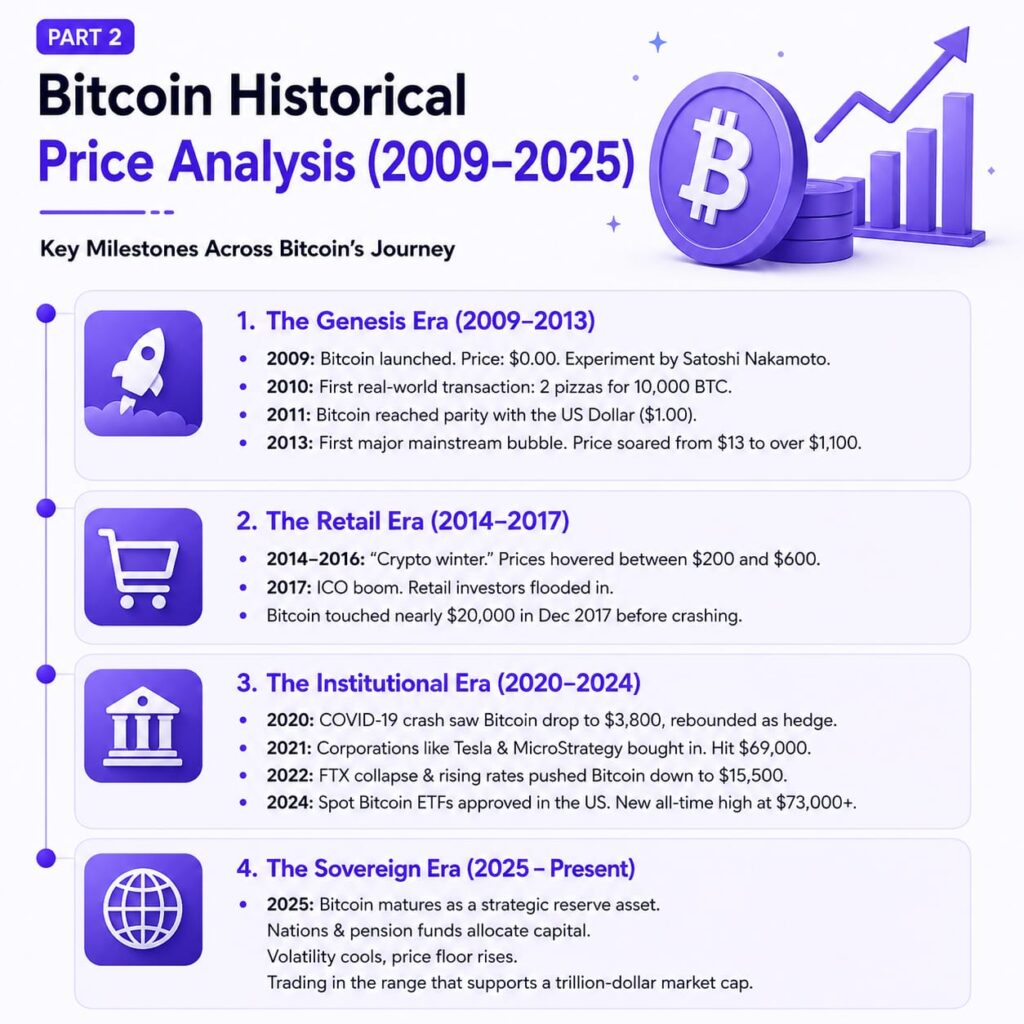
To predict where we are going, we must look at where we have been. A Bitcoin historical price analysis reveals a pattern of boom-and-bust cycles, usually triggered by the “Halving” event (which reduces new supply).
The Genesis Era (2009–2013)
- 2009: Bitcoin launched. Price: $0.00. It was purely an experiment by Satoshi Nakamoto.
- 2010: The first real-world transaction occurred when Laszlo Hanyecz bought two pizzas for 10,000 BTC.
- 2011: Bitcoin reached parity with the US Dollar ($1.00).
- 2013: The first major mainstream bubble. Bitcoin soared from $13 to over $1,100, driven by the collapse of the Mt. Gox exchange and early media hype.
The Retail Era (2014–2017)
- 2014- 2016: A long “crypto winter.” Prices hovered between $200 and $600.
- 2017: The year of the ICO boom. Retail investors flooded in. Bitcoin famously touched nearly $20,000 in December 2017 before crashing. This established Bitcoin as a household name.
The Institutional Era (2020–2024)
- 2020: The COVID-19 crash saw Bitcoin drop to $3,800, only to rebound as a hedge against money printing.
- 2021: Corporations like Tesla and MicroStrategy bought in. Bitcoin hit $69,000.
- 2022: The collapse of FTX and rising interest rates pushed Bitcoin down to $15,500.
- 2024: A pivotal year. The approval of Spot Bitcoin ETFs in the US brought Wall Street capital directly into the market. Bitcoin smashed its previous all-time high, reaching $73,000+ before the halving.
The Sovereign Era (2025 – Present)
- 2025: As we close out this year, we have seen Bitcoin mature. With nations adopting it as a strategic reserve asset and pension funds allocating capital, the volatility has dampened slightly, but the price floor has risen significantly. We are currently trading in a range that solidifies Bitcoin as a trillion-dollar asset class.
The volatility has dampened slightly, but the price floor has risen significantly. We are currently trading in a range that solidifies Bitcoin as a trillion-dollar asset class. While Bitcoin serves as the ultimate anchor for any digital portfolio, many investors look to other blockchain networks for higher percentage returns. To see which ecosystems are positioned to survive the next major market cycle alongside Bitcoin, check out our breakdown of the 10 best cryptocurrencies to invest in for the long term.
Part 3: Bitcoin Price Prediction (2026–2030)
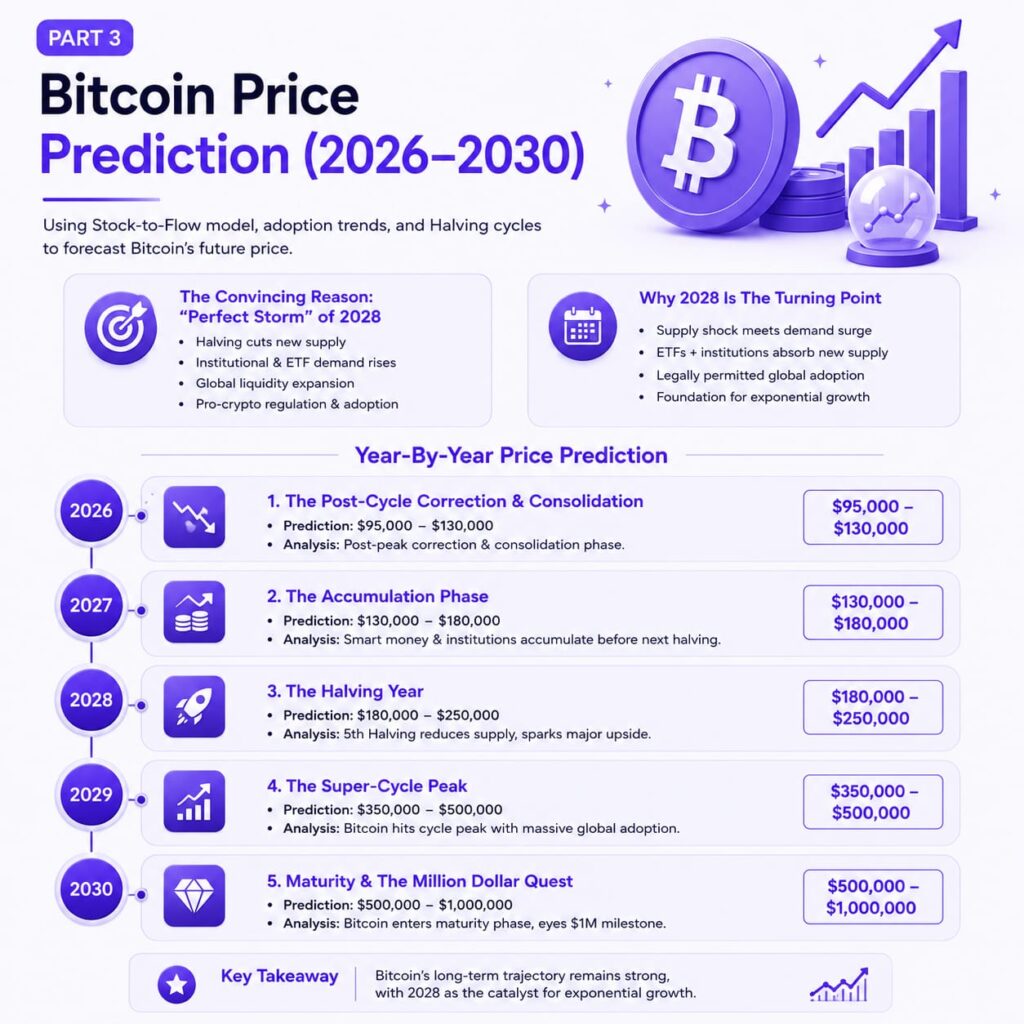
Forecasting the price of an asset as volatile as Bitcoin is challenging, but by analyzing the Stock-to-Flow model, adoption curves (similar to the Internet in the 1990s), and the supply shock from Halvings, we can form a data-driven Bitcoin price prediction.
The Convincing Reason: The “Perfect Storm” of 2028
Why are analysts bullish? The primary driver for the price prediction till 2030 is the 2028 Halving Event.
In 2028, the daily supply of new Bitcoin issued to miners will be cut in half again. Historically, the year following a halving (2013, 2017, 2021, 2025) produces the most aggressive price appreciation. Combine this supply shock with the demand shock from global institutions (ETFs) and sovereign wealth funds, who are now legally permitted to buy Bitcoin, and you have a recipe for exponential growth.
Sovereign nations adopting digital assets as strategic reserves will inevitably introduce a completely new variable into the equation of Bitcoin Value And Price.
Ultimately, tracking miner accumulation behavior and institutional exchange inflows provides a data-backed lens through which we can forecast future Bitcoin Value And Price action.
Year-by-Year Price Prediction
2026: The Post-Cycle Correction & Consolidation
- Prediction: $95,000 – $130,000
- Analysis: Following the bull market peak of late 2025, 2026 will likely be a year of cooling off. History suggests a drawdown, but it won’t be as severe as 2018 or 2022 because the ETF inflows provide a permanent “buy wall.” We expect the price to stabilize above the six-figure mark, becoming a boring but stable asset for the year.
2027: The Accumulation Phase
- Prediction: $130,000 – $180,000
- Analysis: Smart money (institutions) will begin accumulating ahead of the next halving. As the Federal Reserve likely lowers interest rates to stimulate the economy, liquidity will return to risk assets. Bitcoin will slowly grind upward, retesting previous highs.
2028: The Halving Year
- Prediction: $180,000 – $250,000
- Analysis: The 5th Bitcoin Halving occurs. The inflation rate of Bitcoin will drop below that of Gold (less than 1% per year). This is when the “Digital Gold” narrative becomes mathematically undeniable. The price will likely react violently to the upside in the second half of the year.
2029: The Super-Cycle Peak
- Prediction: $350,000 – $500,000
- Analysis: Typically, 12-18 months after a halving, Bitcoin hits its cycle peak. With supply at historic lows and Bitcoin fully integrated into banking apps, retirement plans, and corporate treasuries, the FOMO (Fear Of Missing Out) will be at a nation-state level. This is the year Bitcoin could challenge Gold’s market cap.
2030: Maturity and The Million Dollar Quest
- Prediction: $500,000 – $1,000,000
- Analysis: By 2030, analysts from firms like Ark Invest and VanEck predict Bitcoin could approach or exceed $1 million per coin.
- The Reason: If Bitcoin captures just 10% of the global M2 money supply or 50% of Gold’s market capitalization, the math dictates a price per coin of over $600,000. By 2030, Bitcoin will likely be a standard settlement layer for global finance, making the price a reflection of its utility as the world’s most secure value transfer network.
Before deploying capital into altcoins or high-risk protocols, mastering how the broader economic landscape alters Bitcoin Value And Price is highly advantageous.
A stark divergence often occurs between immediate exchange-rate valuations and the actual, structural Bitcoin Value and Price backed by computational network security.
We expect the price to stabilize above the six-figure mark, becoming a boring but stable asset for the year. However, during these periods of market consolidation, smart investors shift their focus from pure price speculation to active accumulation. If you want to maximize your portfolio before the massive 2028 supply shock takes effect, explore our actionable breakdown of the 14 Best Ways to Earn Cryptocurrency in 2026 to learn how to generate yield while the market rests.
Don’t Let Market Noise Dictate Your Portfolio
Join the CoinExpansion Vanguard Program
You now have the structural framework to separate genuine blockchain utility from fleeting market hype. But the decentralized finance landscape is incredibly noisy, and the difference between generational wealth and a compromised portfolio is access to vetted, real-time data.
When you claim your spot in the CoinExpansion Vanguard Program, you unlock direct access to premium, noise-free crypto intelligence. Receive instant notifications on critical market indicators, exclusive deep dives into emerging decentralized protocols, and actionable strategies to safeguard and scale your capital. Fortify your financial future with elite insights and a community built on technical truth—join our network of dedicated researchers today and always stay one step ahead of the curve.
❓ Frequently Asked Questions (FAQ)
Q: Why does Bitcoin have value if it’s not backed by anything?
A: Bitcoin is backed by the most secure computing network in the world (Proof of Work), its mathematical scarcity (21 million limit), and the consensus of millions of users who accept it as a store of value. Unlike fiat, which is backed by government trust, Bitcoin is backed by code and mathematics.
Q: Can Bitcoin’s price go to zero?
A: Theoretically, yes, if the network stops working or everyone stops using it. However, given its massive global adoption, institutional investment, and decentralized nature, the probability of it going to zero is now statistically negligible.
Q: Is it too late to buy Bitcoin in 2026?
A: If the predictions of a $1 million Bitcoin by 2030 hold, buying now would still offer a significant upside compared to traditional markets. We are likely in the “Early Majority” phase of adoption.
Q: What is the main difference between Bitcoin price and value?
A: Price is what you pay on an exchange (e.g., $100,000). Value is what you get: a decentralized, unseizable asset that allows you to transport wealth anywhere in the world without a bank.
Q: Will the 21 million cap ever change?
A: No. Changing the supply cap would require a “hard fork” where the majority of nodes agree to change the code. Since this would devalue everyone’s holdings, the economic incentives ensure the 21 million cap remains permanent.