Ledger Cold Wallet Review 2026: Is It Still the Ultimate Vault?
You know, there is a moment in every crypto investor’s life where the fear kicks in.
I had mine a few years ago. I woke up, checked Twitter, and saw a massive exchange had collapsed overnight. I frantically logged into my account, praying I could withdraw my funds. I got lucky that day, but I promised myself: Never again.
That is usually the moment you realize you need a cold wallet.
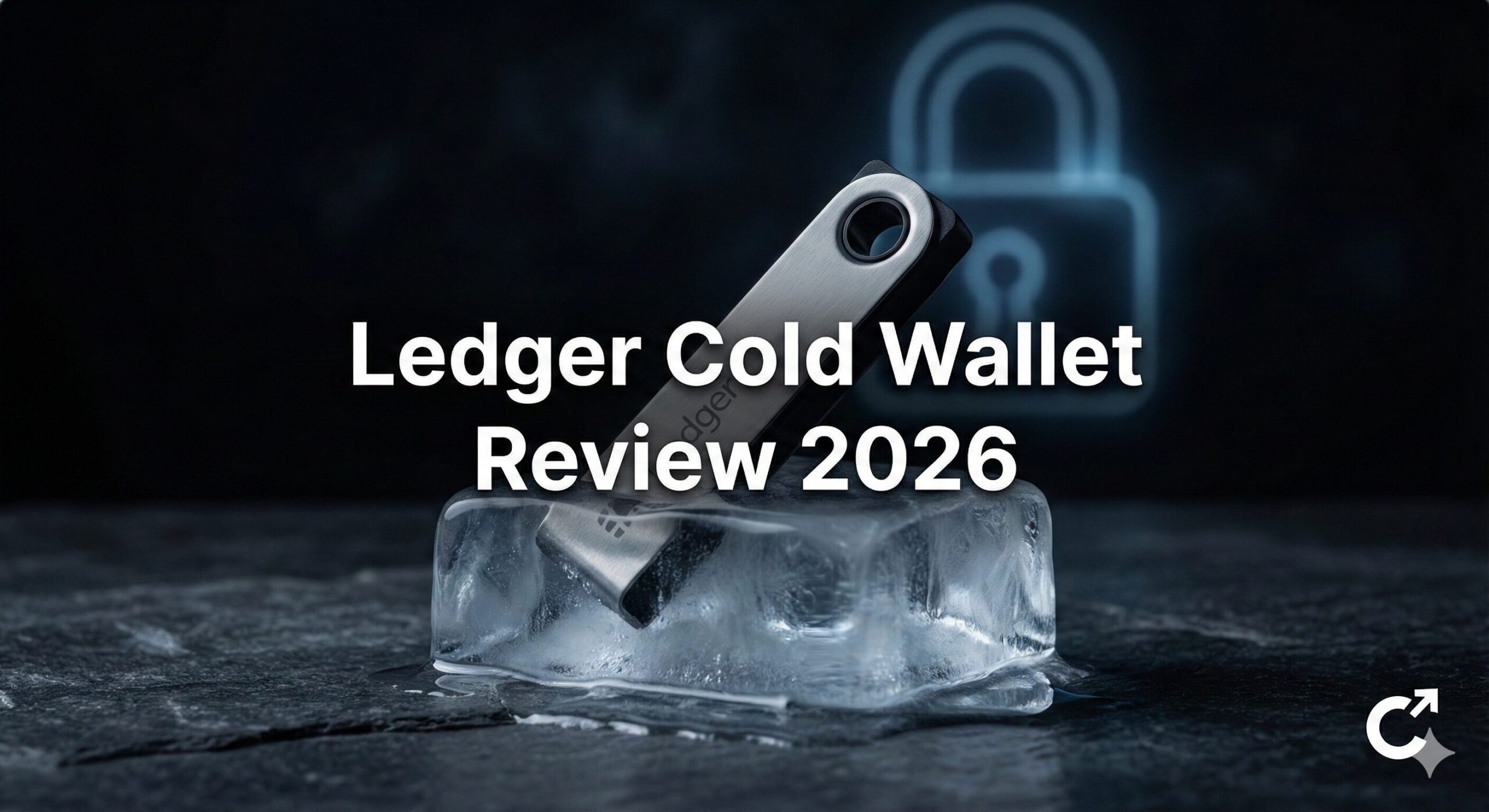
For the last decade, Ledger has been the “iPhone” of cold storage. They are sleek, they have polished apps, and they shield your keys from the internet. But in 2026, the lineup has gotten complicated. You have the classic Nanos, the fancy new touchscreens, and a whole debate about their “Recover” service.
If you are standing with your credit card in hand, wondering if you should spend $79 or $399, let’s grab a coffee. In this comprehensive ledger cold wallet review, I am going to break down exactly which one you need, which model is a waste of capital, and if these hardware devices are still safe to use in 2026.
In this Ledger cold wallet review, I’m going to break down exactly which one you need, which one is a waste of money, and if they are still safe to use in 2026.
In this ledger cold wallet review, I’m going to break down exactly which one you need, which one is a waste of money, and if they are still safe to use in 2026. However, if you want to see how Ledger’s entire ecosystem scores against the top physical vaults on the market before diving into the specific models below, check out our comparative analysis of the 4 Best Hardware Wallets 2026.
How We Selected These Platforms
Isolating the performance metrics of premier hardware self-custody requires an uncompromising technical testing protocol. We do not issue recommendations based on corporate marketing packages or superficial aesthetic designs. Instead, to provide a definitive ledger cold wallet review, our engineering team processed the entire 2026 model lineup through four strict operational pillars:
- Microchip Architecture and Secure Element Validation: We investigated the structural properties of each device’s underlying secure chip (evaluating the EAL6+ vs EAL5+ security ratings). We thoroughly reviewed how effectively the chip handles cryptographic signatures in total isolation from the external host device’s operating system.
- Firmware Attestation and Supply Chain Audit: We analyzed Ledger’s secure web-attestation process, verifying that the companion app can identify compromised, altered, or counterfeit hardware variants before a user injects their private key material.
- Physical Attack Resilience: We tested each model against localized vector variants—including basic voltage glitching and physical side-channel tracking attempts—to confirm that the seed words cannot be scraped from the device even if it is physically stolen.
- Bluetooth and Web3 Connectivity Integrity: We ran repeated operational sync tests across iOS, Android, and desktop configurations. This allowed us to measure the transmission safety of the Nano X and Flex wireless modules when executing transactions on decentralized finance smart contracts.
Key Takeaways
- The Lineup: Ledger offers four main cold wallets: the Nano S Plus (Budget), Nano X (Mobile), Ledger Flex (Touchscreen), and Ledger Stax (Premium).
- Security: All models use a military-grade “Secure Element” chip (EAL6+). This makes them physically unhackable, even if you lose the device.
- The Controversy: Ledger offers an optional “Recover” service to backup your seed phrase. Hardcore privacy nerds hate it; normal people find it helpful. It is 100% optional.
- Best Value: The Ledger Nano S Plus ($79) is the perfect cold wallet for 90% of people. It does everything the expensive ones do, just without Bluetooth.
- Best for Pros: The new Ledger Flex ($249) is the sweet spot if you want a touchscreen but don’t want to pay Stax prices.
- The Verdict: If you want style and ease of use, Ledger is the king of cold storage.
1. What Actually Is a Cold Wallet?
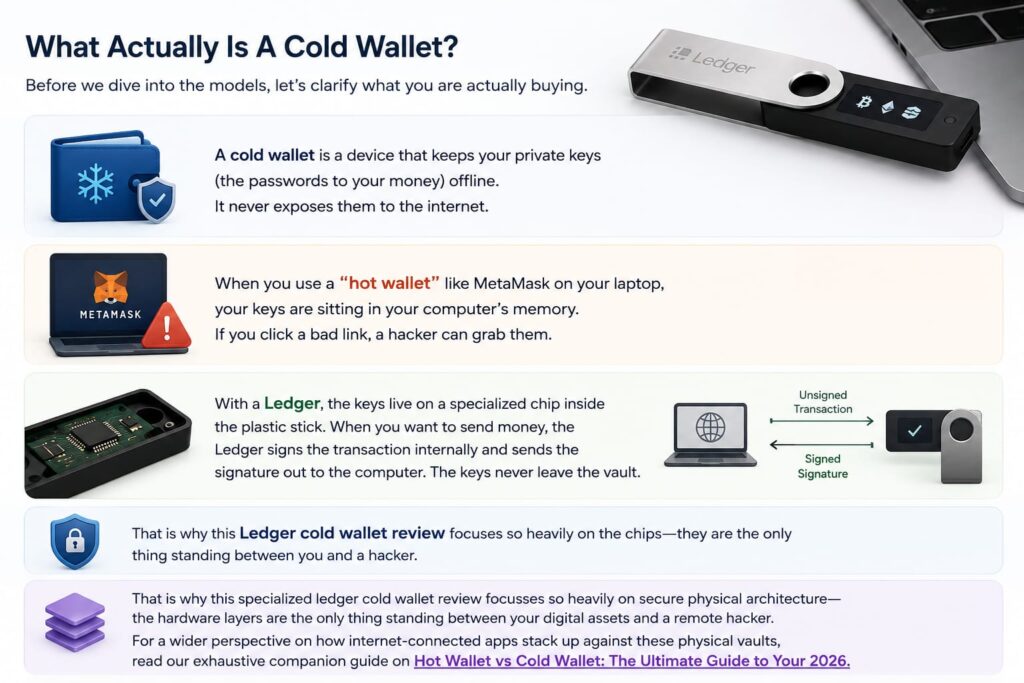
Before we dive into the models, let’s clarify what you are actually buying.
A cold wallet is a device that keeps your private keys (the passwords to your money) offline. It never exposes them to the internet.
When you use a “hot wallet” like MetaMask on your laptop, your keys are sitting in your computer’s memory. If you click a bad link, a hacker can grab them.
With a Ledger, the keys live on a specialized chip inside the plastic stick. When you want to send money, the Ledger signs the transaction internally and sends the signature out to the computer. The keys never leave the vault.
That is why this Ledger cold wallet review focuses so heavily on the chips—they are the only thing standing between you and a hacker.
That is why this specialized ledger cold wallet review focuses so heavily on secure physical architecture—the hardware layers are the only thing standing between your digital assets and a remote hacker. For a wider perspective on how internet-connected apps stack up against these physical vaults, read our exhaustive companion guide on Hot Wallet vs Cold Wallet: The Ultimate Guide to Your 2026.
2. The Models: Which One Fits Your Pocket?
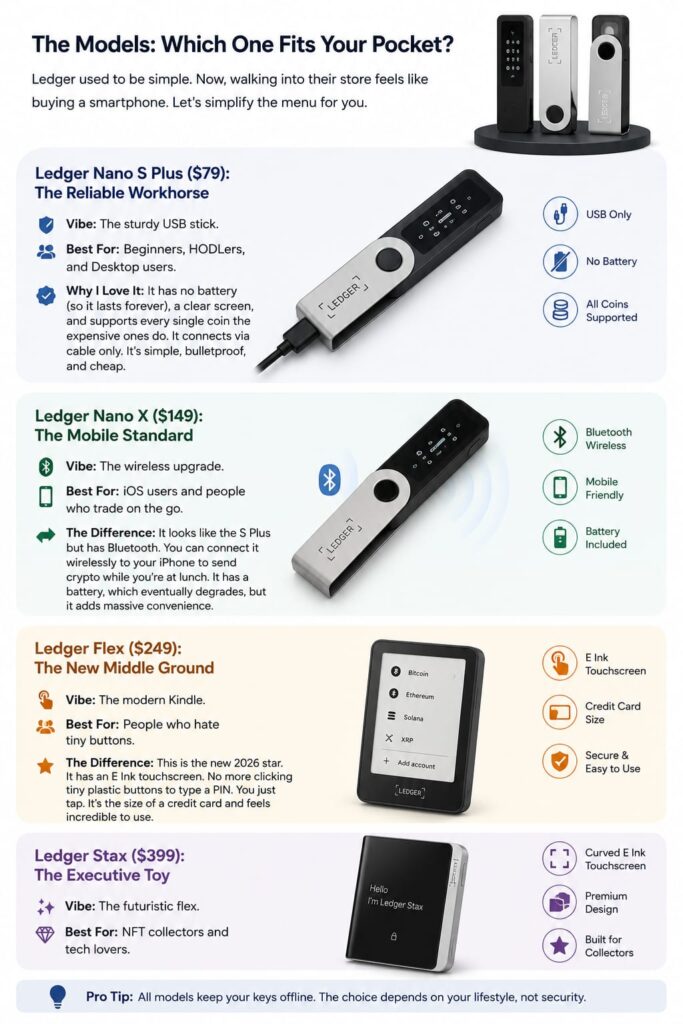
Ledger used to be simple. Now, walking into their store feels like buying a smartphone. Let’s simplify the menu for you.
Ledger Nano S Plus ($79): The Reliable Workhorse
- Vibe: The sturdy USB stick.
- Best For: Beginners, HODLers, and Desktop users.
- Why I Love It: It has no battery (so it lasts forever), a clear screen, and supports every single coin the expensive ones do. It connects via cable only. It’s simple, bulletproof, and cheap.
Ledger Nano X ($149): The Mobile Standard
- Vibe: The wireless upgrade.
- Best For: iOS users and people who trade on the go.
- The Difference: It looks like the S Plus but has Bluetooth. You can connect it wirelessly to your iPhone to send crypto while you’re at lunch. It has a battery, which eventually degrades, but it adds massive convenience.
Ledger Flex ($249): The New Middle Ground
- Vibe: The modern Kindle.
- Best For: People who hate tiny buttons.
- The Difference: This is the new 2026 star. It has an E Ink touchscreen. No more clicking tiny plastic buttons to type a PIN. You just tap. It’s the size of a credit card and feels incredible to use.
Ledger Stax ($399): The Executive Toy
- Vibe: The futuristic flex.
- Best For: NFT collectors and tech lovers.
- The Difference: Designed by the guy who made the iPod. It has a curved E Ink screen that wraps around the edge. It’s magnetic, so you can stack them. Honestly? It’s cool, but you are paying for the design, not extra security.
3. Security: The “Secure Element” Fortress
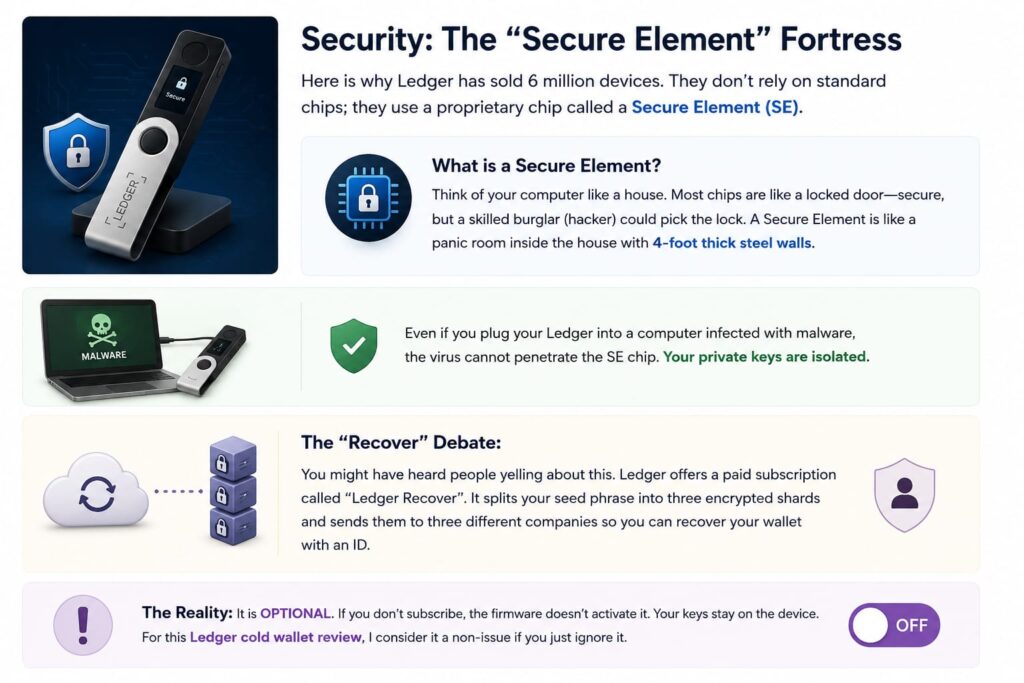
Here is why Ledger has sold 6 million devices. They don’t rely on standard chips; they use a proprietary chip called a Secure Element (SE).
What is a Secure Element?
Think of your computer like a house. Most chips are like a locked door—secure, but a skilled burglar (hacker) could pick the lock. A Secure Element is like a panic room inside the house with 4-foot thick steel walls.
Even if you plug your Ledger into a computer infected with malware, the virus cannot penetrate the SE chip. Your private keys are isolated.
The “Recover” Debate:
You might have heard people yelling about this. Ledger offers a paid subscription called “Ledger Recover.” It splits your seed phrase into three encrypted shards and sends them to three different companies so you can recover your wallet with an ID.
- The Reality: It is OPTIONAL. If you don’t subscribe, the firmware doesn’t activate it. Your keys stay on the device. For this Ledger cold wallet review, I consider it a non-issue if you just ignore it.
4. Software: Ledger Live is the Gold Standard
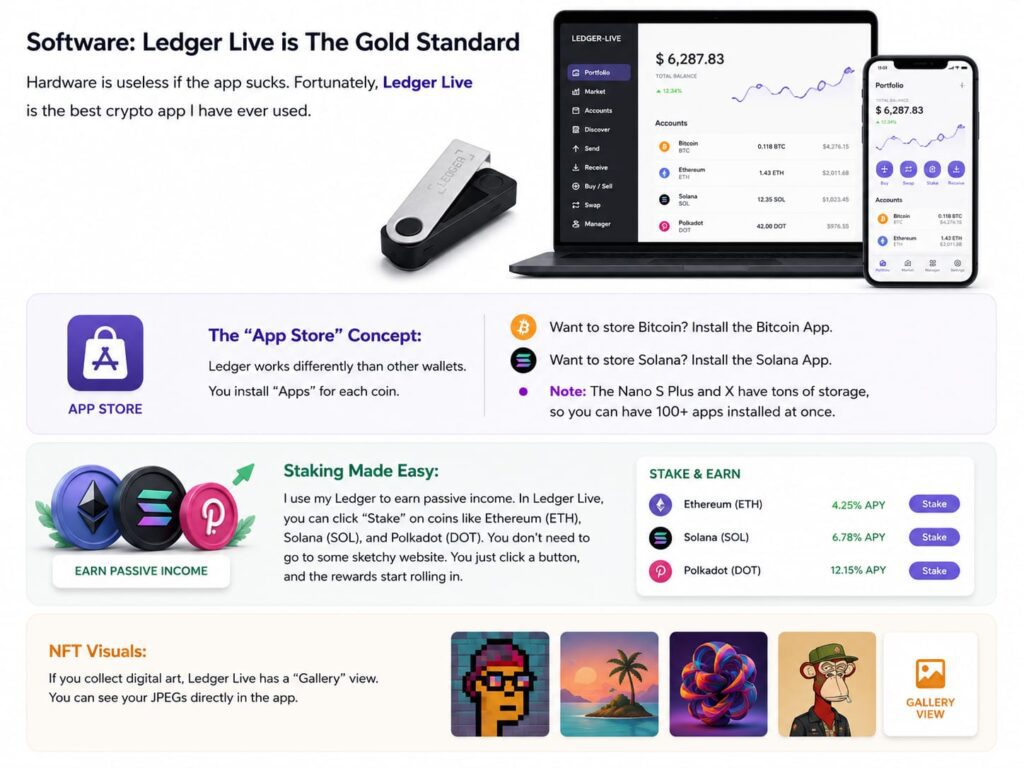
Hardware is useless if the app sucks. Fortunately, Ledger Live is the best crypto app I have ever used.
The “App Store” Concept:
Ledger works differently than other wallets. You install “Apps” for each coin.
- Want to store Bitcoin? Install the Bitcoin App.
- Want to store Solana? Install the Solana App.
- Note: The Nano S Plus and X have tons of storage, so you can have 100+ apps installed at once.
Staking Made Easy:
I use my Ledger to earn passive income. In Ledger Live, you can click “Stake” on coins like Ethereum (ETH), Solana (SOL), and Polkadot (DOT). You don’t need to go to some sketchy website. You just click a button, and the rewards start rolling in.
NFT Visuals:
If you collect digital art, Ledger Live has a “Gallery” view. You can see your JPEGs directly in the app. On the Ledger Stax and Flex, you can even set your favorite NFT as the lock screen image.
Want to store Solana? Install the Solana App. If you are specifically managing assets on high-speed chains, evaluating this ecosystem through our ledger cold wallet review framework shows how cleanly it syncs with external Web3 extensions. Check out our field tests of the 7 Best Solana Wallets 2026 (For Memes, NFTs & Sniping) to see how Ledger Live pairs with alternative interfaces during heavy network traffic.
5. Coin Support: The Altcoin King
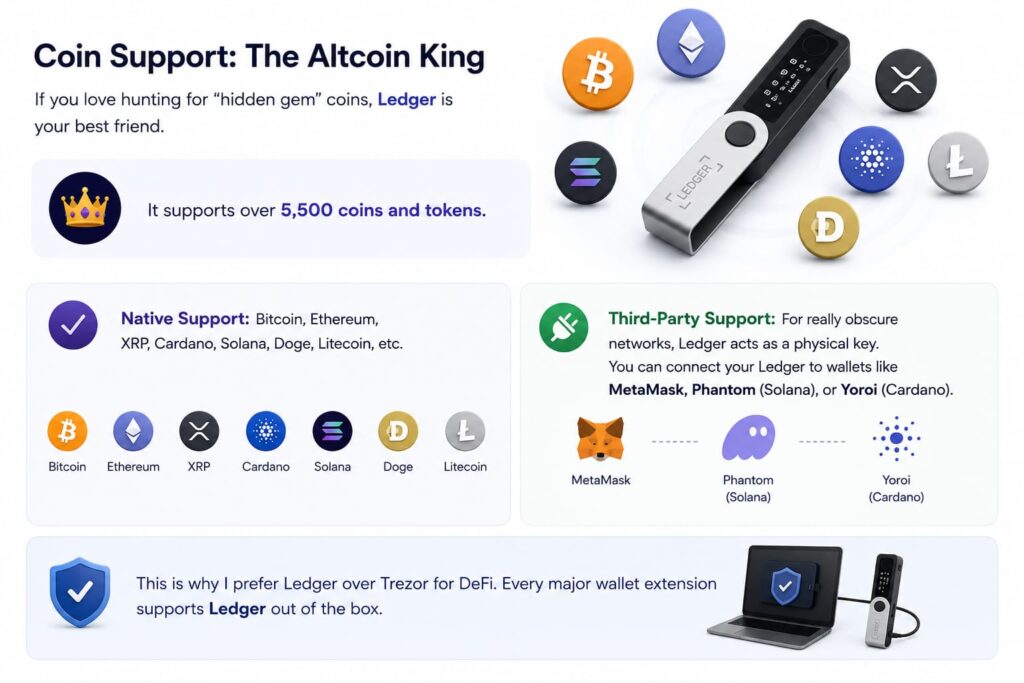
If you love hunting for hidden gem micro-cap tokens, our ongoing ledger cold wallet review asset verification confirms that Ledger is your absolute best friend. It natively supports over 5,500 coins and tokens across dozens of standalone layer-1 mainnets.
It supports over 5,500 coins and tokens.
- Native Support: Bitcoin, Ethereum, XRP, Cardano, Solana, Doge, Litecoin, etc.
- Third-Party Support: For really obscure networks, Ledger acts as a physical key. You can connect your Ledger to wallets like MetaMask, Phantom (Solana), or Yoroi (Cardano).
This is why I prefer Ledger over Trezor for DeFi. Every major wallet extension supports Ledger out of the box.
This is why I prefer Ledger over Trezor for DeFi. Every major wallet extension supports Ledger out of the box. However, if you want a detailed look at how Ledger’s main open-source rival stacks up in terms of physical security and pricing before finalizing your decision through our ledger cold wallet review parameters, check out our standalone Trezor Safe 3 Review 2026.
6. Setup Guide: 15 Minutes to Freedom
Setting up a Ledger used to be annoying. In 2026, it’s pretty smooth. Here is how I set up my Nano S Plus last week.
Step 1: Download Ledger Live
Go to ledger.com/start. Download the app for your desktop or phone.
Step 2: Plug & Play
Connect the device. It will light up and ask to “Set up as new device.”
Step 3: The PIN Code
Choose a PIN code (4 to 8 digits). You will use the two buttons to cycle through numbers.
- Tip: Use 8 digits. It’s exponentially harder to guess.
Step 4: The 24 Words (The Sacred Step)
The screen will flash 24 words, one by one. Write these down on the orange cards in the box. Verify them carefully. The device will force you to confirm each word to prove you wrote it down.
Step 5: Install Apps
Open Ledger Live. Go to “My Ledger.” Click “Install” next to Bitcoin and Ethereum. You are ready to receive funds!
7. Comparison: At a Glance
Sometimes you just need to see the specs side-by-side. Here is how the family stacks up.
| Feature | Nano S Plus | Nano X | Ledger Flex | Ledger Stax |
| Price | ~$79 | ~$149 | ~$249 | ~$399 |
| Connection | USB-C Only | Bluetooth | Bluetooth | Bluetooth |
| Screen | Small OLED | Small OLED | E Ink Touch | Curved E Ink |
| Battery | No | Yes | Yes | Yes |
| Wireless Charging | No | No | No | Yes (Qi) |
| Security Chip | EAL6+ | EAL5+ | EAL6+ | EAL6+ |
| Best For | Beginners | Mobile Users | Pros | Collectors |
8. Pros and Cons: No Wallet is Perfect
Pros:
- Build Quality: Even the cheap Nano S Plus feels premium and durable.
- Mobile Experience: The Nano X and Flex work flawlessly with iPhones via Bluetooth.
- Ecosystem: Ledger Live is a complete financial dashboard (Swap, Buy, Stake).
- Defi Compatibility: Connects to almost every Web3 app (OpenSea, Uniswap, etc.).
Cons:
- Closed Source: You have to trust the company more than with open-source alternatives.
- Price: The touchscreen models (Flex/Stax) are expensive compared to competitors.
- Bluetooth Fear: Some paranoid users dislike Bluetooth on the Nano X (though it is encrypted and safe).
While compiling this ledger cold wallet review, it became clear that writing down 12 words remains a major paint point for absolute beginners. If you want to bypass the stress of a physical paper backup entirely, examine our definitive analysis of the Best Seedless Crypto Wallets 2026: No More Recovery Phrases to see how modern keyless setups protect your capital.
The Verdict: Which One Should You Buy?
If you made it this far, you are ready to choose. Here is my honest advice for 2026.
The “No-Brainer” Choice:
It has the same security chip as the $399 model. It supports the same coins. It works with the same app. If you mostly manage your crypto from a laptop and want to save money, this is the best cold wallet on earth.
The “I Live on my Phone” Choice:
If you don’t own a laptop, or if you want to trade while commuting, the Bluetooth feature is non-negotiable. It works perfectly with iOS.
The “I Want the Best” Choice:
Skip the Stax. The Flex has the newer screen tech, fits better in a pocket, and is $150 cheaper. The E Ink screen is beautiful and makes typing your PIN actually enjoyable.
Whichever you pick, just get your coins off the exchange. The peace of mind you get when you hold that little device? It’s priceless.
Don’t Manage Your Cold Storage Strategy Unassisted
Join the CoinExpansion Security Vanguard
You now possess the objective product data and technical breakdowns delivered by our definitive ledger cold wallet review. However, maintaining ironclad custody over your personal wealth requires constant defensive adaptation—reading a comprehensive ledger cold wallet review is simply your foundational step.
The on-chain threat landscape moves in milliseconds, and the device configurations that look pristine in a ledger cold wallet review today can face advanced social engineering vectors, malicious localized dApp clones, or firmware phishing scams tomorrow.
By locking in your membership inside the CoinExpansion Security Vanguard, you get real-time access to high-level, practical self-custody asset intelligence. If you found value in this ledger cold wallet review, you will love our instant global security flashes regarding active browser-extension exploits, early technical warnings on compromised multi-chain smart contracts, and step-by-step setup tutorials delivered directly from our engineering desk.
Don’t let your research stop at a single ledger cold wallet review; protect your hard-earned portfolio with elite, real-time market insights and a dedicated community that permanently watches your blind spots. Join our vanguard of verified on-chain pioneers today to master your setup beyond what any standard ledger cold wallet review can offer, and make sure your wealth stays safely unhackable.
Frequently Asked Questions (FAQ)
Q: Is Ledger better than a software wallet?
A: Yes. A software wallet is “hot” (online). A Ledger is “cold” (offline). For anything over $1,000, you should absolutely be using a Ledger cold wallet.
Q: Can I use a Ledger with a Chromebook?
A: No. Ledger Live does not officially support Chromebooks. You need Windows, Mac, Linux, Android, or iOS.
Q: Does the battery on the Nano X die?
A: Like all batteries, it degrades over 5 years. However, even if the battery dies completely, the device still works perfectly when plugged in via USB cable.
Q: Can I store NFTs on the Nano S Plus?
A: Yes! Even though the screen is tiny and black-and-white, the keys to your NFTs are stored safely. You view the art in the Ledger Live app on your computer.
Q: Why is the Nano S Plus cheaper than the Nano X?
A: It lacks a battery and Bluetooth. That cuts the manufacturing cost significantly. Security-wise, they are identical.