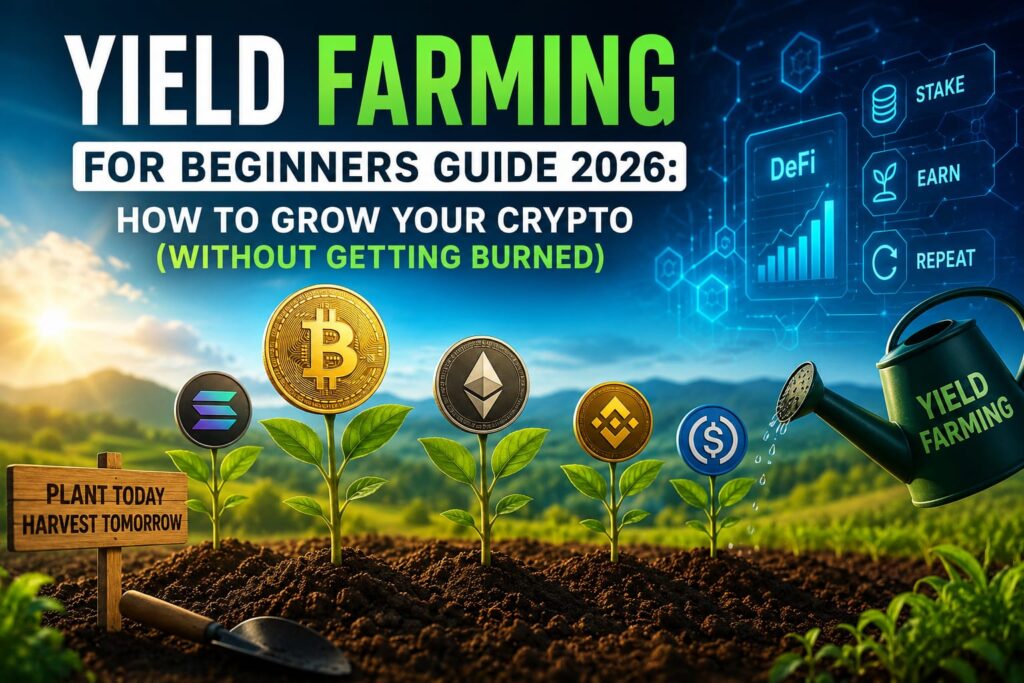
The Ultimate Yield Farming for Beginners Guide 2026: How to Grow Your Crypto (Without Getting Burned)
Welcome to the ultimate Yield Farming for Beginners Guide, where we break down exactly how to put your crypto assets to work.
Imagine you own a small plot of fertile land. You could just let it sit there, hoping the value of the land goes up over ten years. That is like buying Bitcoin and holding it. It’s safe, but it’s passive.
But what if you planted seeds? What if you watered them, tended to them, and harvested a crop every single week? Suddenly, that same plot of land is generating active income. You aren’t just hoping for the price to rise; you are actively producing value.
In the world of crypto, this is Yield Farming. It is one of the most powerful ways to earn cryptocurrency in 2026, offering returns that can make traditional bank interest look like a rounding error. But unlike a simple savings account, this is active work. It requires strategy, knowledge, and a healthy respect for the risks involved.
In this yield farming for beginners guide, we are going to strip away the complex DeFi jargon. We will explain exactly how it works using simple analogies, reveal the best platforms to start on, and most importantly, teach you how to avoid the “crop killers” like impermanent loss.
If you want to earn passive income without getting burned by complex DeFi mechanics, this Yield Farming for Beginners Guide is built specifically for you.
Before diving into complex smart contracts and liquidity pools, it is vital to have a rock-solid understanding of fundamental digital assets. If you are brand new to the ecosystem, we highly recommend reading The Ultimate Bitcoin Crypto Guide to establish your foundational knowledge before deploying capital into decentralized protocols.
How We Selected These Yield Farming Platforms
To protect your capital from smart contract failures, malicious rug pulls, and hidden fee structures, we evaluated over 15 different DeFi protocols. Our final top 5 recommendations were selected based on a strict four-part verification framework:
- Total Value Locked (TVL) & Historical Liquidity: We exclusively prioritized platforms with deep, mature liquidity pools that can withstand sharp market sell-offs without collapsing.
- Smart Contract Security Audits: Every protocol featured has undergone multiple independent security reviews by top-tier Web3 auditing firms (such as CertiK or OpenZeppelin) to ensure clean code execution.
- User Experience for Beginners: We selected protocols featuring clean, intuitive web interfaces that make adding liquidity, tracking yields, and withdrawing assets straightforward.
- Impermanent Loss Mitigation: We included single-sided lending options and stablecoin-only platforms to give new investors options that completely eliminate or radically reduce volatility risks.
Total Value Locked (TVL) & Historical Liquidity: We exclusively prioritized platforms with deep, mature liquidity pools that can withstand sharp market sell-offs without collapsing. We cross-referenced on-chain data using authoritative tracking tools like DeFiLlama to ensure the capital inside these protocols is genuinely growing.
Key Takeaways
- The Core Concept: Yield farming is lending your crypto to a Decentralized Exchange (DEX) so other people can trade. In return, you earn fees.
- Farming vs. Staking: Staking secures a network (like Ethereum); Farming provides liquidity for trading. Farming is generally higher risk and higher reward.
- The “Crop Killer”: Impermanent Loss is the biggest risk you face. We explain it simply below so you don’t get caught off guard.
- Best for Beginners: Uniswap and Aave remain the safest and most user-friendly places to start your farming journey.
- 2026 Strategy: The “gold rush” days of 10,000% APY are gone. The smart money is now in “Real Yield”—earning sustainable fees from stablecoin pairs and blue-chip assets.
Why Trust Us? (Our Farming Scars)
We have been yield farming since “DeFi Summer” in 2020. We have seen it all—from the thrill of earning 100% APY on a new token to the pain of watching a “farm token” crash to zero overnight.
We have tested every major protocol on Ethereum, Solana, and Arbitrum. We know which ones have stood the test of time and which ones are houses of cards. This guide is built on years of real wins and painful lessons, designed to keep your capital safe.
We built this Yield Farming for Beginners Guide based on years of real-world experience, ensuring you avoid the common traps that drain new investors.
When putting together this Yield Farming for Beginners Guide, our primary focus was on evaluating platforms with deep liquidity and high security.
What is Yield Farming? (The Airport Currency Booth Analogy)
To understand yield farming, forget about crypto for a second. Think about a currency exchange booth at an international airport.
Travelers line up to swap Dollars for Euros. The booth charges a small fee for every swap. To run this business, the booth needs a big pile of both Dollars and Euros in the safe. If they run out of Euros, business stops.
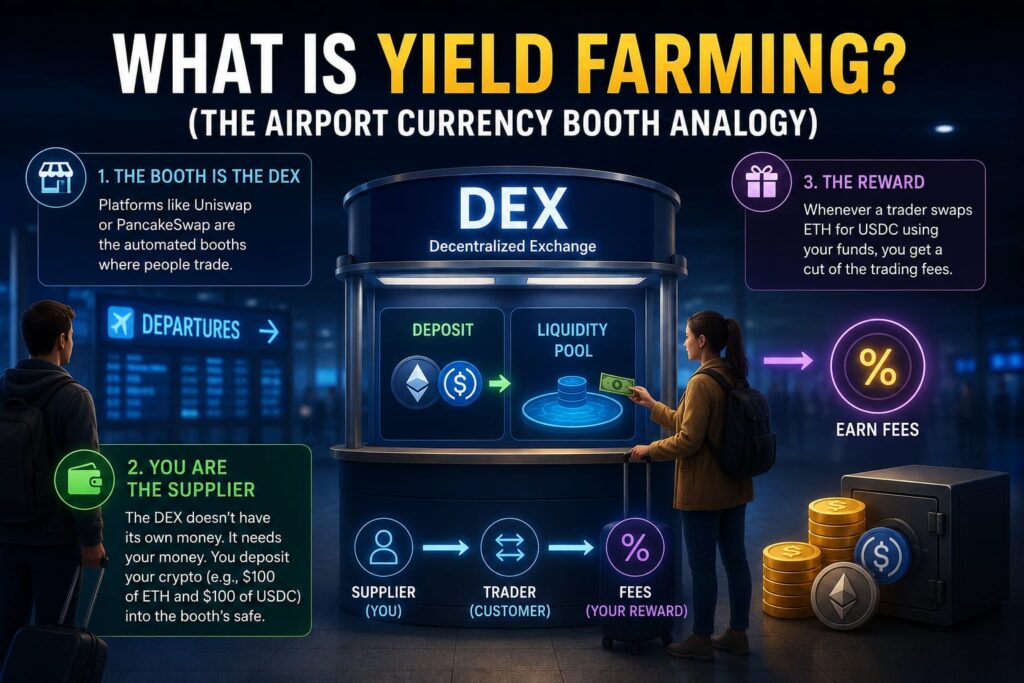
In Yield Farming:
- The Booth is the DEX: Platforms like Uniswap or PancakeSwap are the automated booths where people trade.
- You are the Supplier: The DEX doesn’t have its own money. It needs your money. You deposit your crypto (e.g., $100 of ETH and $100 of USDC) into the booth’s safe.
- The Reward: Whenever a trader swaps ETH for USDC using your funds, you get a cut of the trading fee.
You are essentially acting as the bank. You are providing the “liquidity” that makes trading possible, and you get paid for it.
The core concept we cover in this Yield Farming for Beginners Guide relies on understanding how decentralized exchanges use your funds to facilitate trades.
As you will learn throughout this Yield Farming for Beginners Guide, acting as the ‘bank’ or liquidity provider is exactly how you generate those consistent returns.
Because this entire process relies on automated smart contracts rather than a centralized corporate middleman, you must use a decentralized platform to participate. If you are still unclear on how these platforms differ from standard trading apps, check out our complete breakdown on The Ultimate Guide to CEX VS DEX Crypto Exchanges to understand how custodial and non-custodial environments operate.
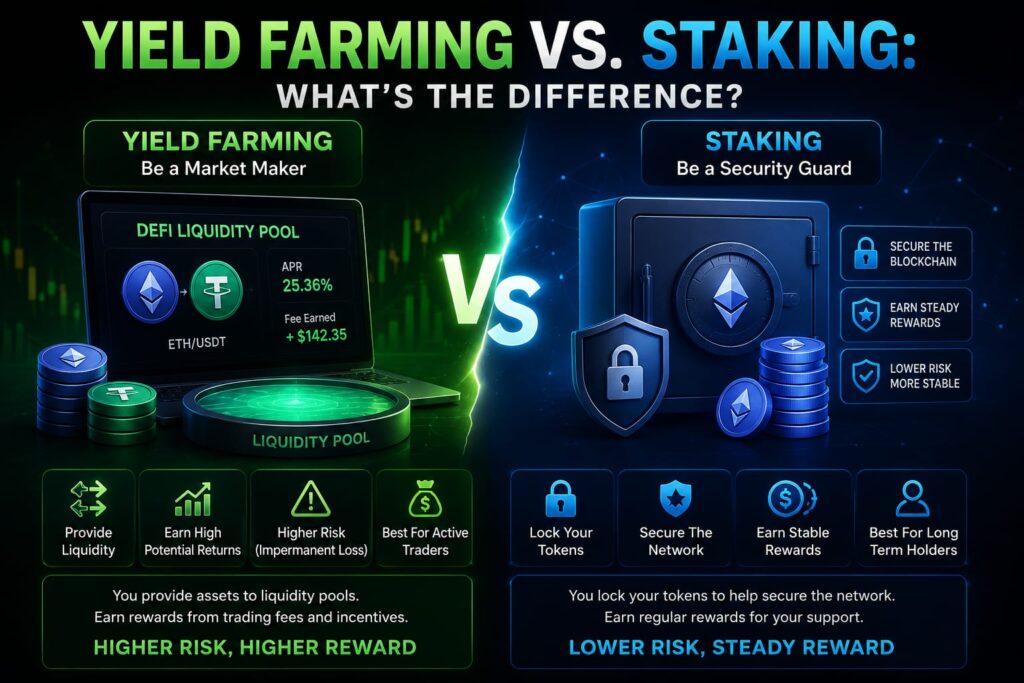
Yield Farming vs. Staking: What’s the Difference?
A common question we must address in this Yield Farming for Beginners Guide is the distinct difference between simply securing a network and providing active trading liquidity.
These terms are often used interchangeably, but they are very different.
- Staking is like being a security guard. You lock up your tokens to help secure the blockchain network (like Ethereum). It is generally safer and simpler.
- Yield Farming is like being a market maker. You are providing assets for people to trade against. It is more complex, requires you to pair two different assets, and carries unique risks like price divergence.
The Silent Killer: What is Impermanent Loss?
This is the most important concept to grasp. If you skip this, you will lose money.
The Scenario: Imagine you deposit 1 ETH (worth $1,000) and 1,000 USDC into a farming pool. Your total value is $2,000.
The Shift: Suddenly, the price of ETH explodes to $2,000. On the open market, your ETH is now worth twice as much. But inside the liquidity pool, the automated system sells some of your expensive ETH to buy more USDC to keep the pool balanced (50/50).
The Result: If you withdraw now, you might end up with 0.7 ETH and 1,400 USDC. Even though your total dollar value went up, you have less ETH than if you had just held it in your wallet. That difference—the money you “missed out on” by farming instead of holding—is called Impermanent Loss.
The Lesson: Yield farming is best when asset prices are stable. If you think a coin is going to “moon” (go up 10x), do not farm it. Just hold it. Farm with assets that you expect to trade sideways or move together.
No Yield Farming for Beginners Guide would be complete without a deep dive into Impermanent Loss, which remains the single biggest risk to your capital.
5 Best Yield Farming Platforms for Beginners in 2026
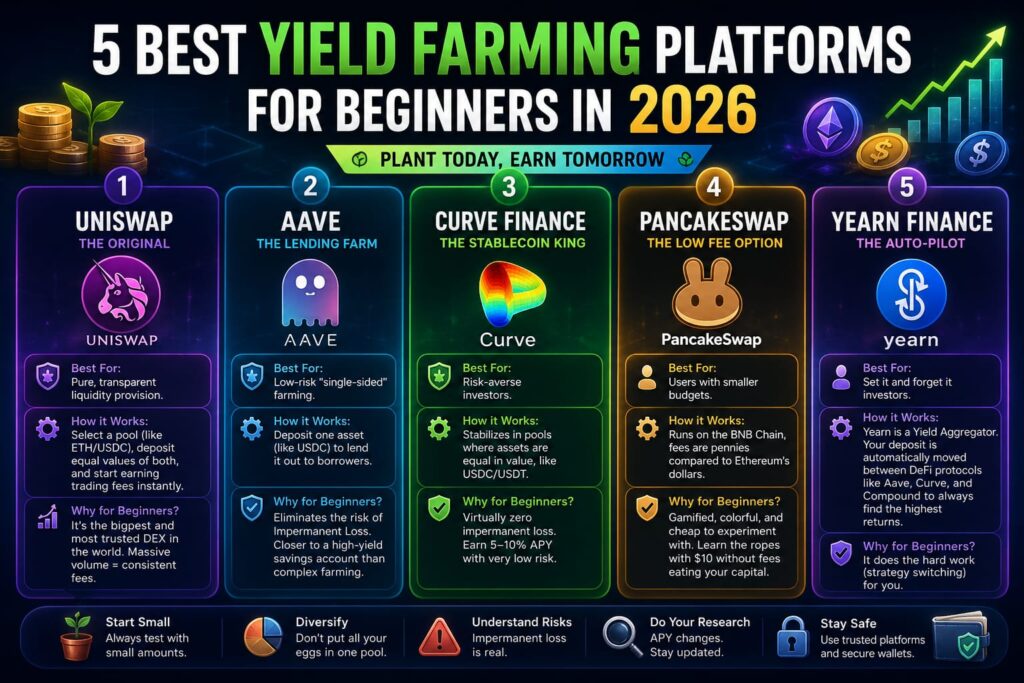
If you are ready to plant your first seeds, these are the safest fields to plow.
1. Uniswap (The Original)
- Best For: Pure, transparent liquidity provision.
- How It Works: You select a “pool” (like ETH/USDC), deposit equal values of both, and start earning trading fees instantly.
- Why for Beginners? It is the biggest and most trusted DEX in the world. The volume is massive, meaning you earn consistent fees.
2. Aave (The Lending Farm)
- Best For: Low-risk “single-sided” farming.
- How It Works: You don’t need to pair assets here. You simply deposit one asset (like USDC) to lend it out to borrowers.
- Why for Beginners? It eliminates the risk of Impermanent Loss completely because you are only depositing one asset. It’s closer to a high-yield savings account than to complex farming.
3. Curve Finance (The Stablecoin King)
- Best For: Risk-averse investors.
- How It Works: Curve specializes in pools where assets are equal in value, like USDC/USDT.
- Why for Beginners? Because both assets are stablecoins worth $1, there is virtually zero impermanent loss. You can earn 5-10% APY with very low risk compared to volatile crypto pools.
4. PancakeSwap (The Low Fee Option)
- Best For: Users with smaller budgets.
- How it Works: It runs on the BNB Chain, so transaction fees are pennies (compared to Ethereum’s dollars). It offers “Farms” where you stake your liquidity tokens to earn the CAKE token.
- Why for Beginners? It is gamified, colorful, and cheap to experiment with. You can learn the ropes with $10 without fees eating into your capital.
5. Yearn Finance (The Auto-Pilot)
- Best For: “Set it and forget it” investors.
- How it Works: Yearn is a “Yield Aggregator.” You deposit your crypto, and Yearn’s automated robots move it around between different DeFi protocols (like Aave, Curve, and Compound) to always find the highest interest rate for you.
- Why for Beginners? It does the hard work of strategy switching for you.
In the next section of our Yield Farming for Beginners Guide, we rank the safest and most reliable platforms to deploy your first smart contract.
Uniswap remains a top recommendation in every Yield Farming for Beginners Guide because of its massive trading volume and intuitive interface.
Your 2026 Farming Strategy: The “Stable-Core” Approach
Don’t chase 1000% APY on a meme coin. That is how you lose everything. Here is a safe path for 2026:
- Start with Stablecoins: Go to Curve or Aave and farm with USDC or USDT. Aim for 5-10% steady returns. If you are unfamiliar with how these fiat-pegged tokens maintain their value, read our quick guide on what stablecoins are and how they work before depositing your funds.
- Graduate to Blue Chips: Once confident, try an ETH/USDC pool on Uniswap. You will earn higher fees but will be exposed to some price movement.
- Reinvest: Take your earnings (the “harvest”) and either compound them back into the farm or convert them to Bitcoin for long-term storage.
Take your earnings (the ‘harvest’) and either compound them back into the farm or convert them to Bitcoin. Just remember, as your portfolio grows, do not leave massive funds sitting in a hot wallet. We highly recommend moving your long-term harvests offline; you can compare the best cold storage options in our ledger review alongside our Trezor review.
Ready to accelerate your passive income journey without navigating the complexities of DeFi alone? Don’t build your yield farming channels in isolation. Become a cryptocurrency pioneer by locking in your spot today. When you join our ecosystem, you get direct access to advanced liquidity-routing blueprints, early alerts on audited high-yield pools, and a private network of top-tier Web3 creators sharing what is working right now. Discover exactly how to scale your portfolio and check what premium benefits are provided by the CoinExpansion Pioneer Program before registration closes.
Q: How much money do I need to start?
A: On Ethereum-based platforms (Uniswap, Aave), you might need $500+ to make the gas fees worth it. On cheaper chains like Base, Arbitrum, or BNB Chain (PancakeSwap), you can start learning with as little as $10.
Q: Can I lose more than I deposit?
A: In standard yield farming, no. The worst case is usually that the token price drops to zero or that a smart contract bug drains the pool. You won’t owe money, but your investment can go to zero. By following the ‘Stable-Core’ strategy outlined in this Yield Farming for Beginners Guide, you can effectively shield your portfolio from massive price drops.
Q: Is yield farming taxable?
Yes. In most countries, every time you claim your harvest rewards, it is a taxable event (income tax). Swapping tokens is also taxable (capital gains). It can get complicated, so use crypto tax software.
Q: What is “Real Yield”?
A: This is a buzzword you will hear in 2026. It means the yield comes from actual revenue (trading fees generated by real users) rather than the protocol just printing new “reward tokens” out of thin air. Always look for Real Yield (like Uniswap) over inflationary rewards.